Tuesday, May 19, 2020

Live Broadcast Tabletop game - support of Lets Roll and KeyCon 2020

Another journey into the history of Austerlitz.

This time with some adjusted forces, to see what Bonaparte might have accomplished the storming of Pratzen with.

during deployment Dan-O captured this image
We had plans to record this session fully, yet something happened in the software (or operation of it) and the recording was lost.

I still managed to grab a few still shots and this wonderful one from one of the many players from the US east coast in support of Lets Roll 2020.  Including a key one of the Snappy Nappy operations team.

forces fully deployed at game start

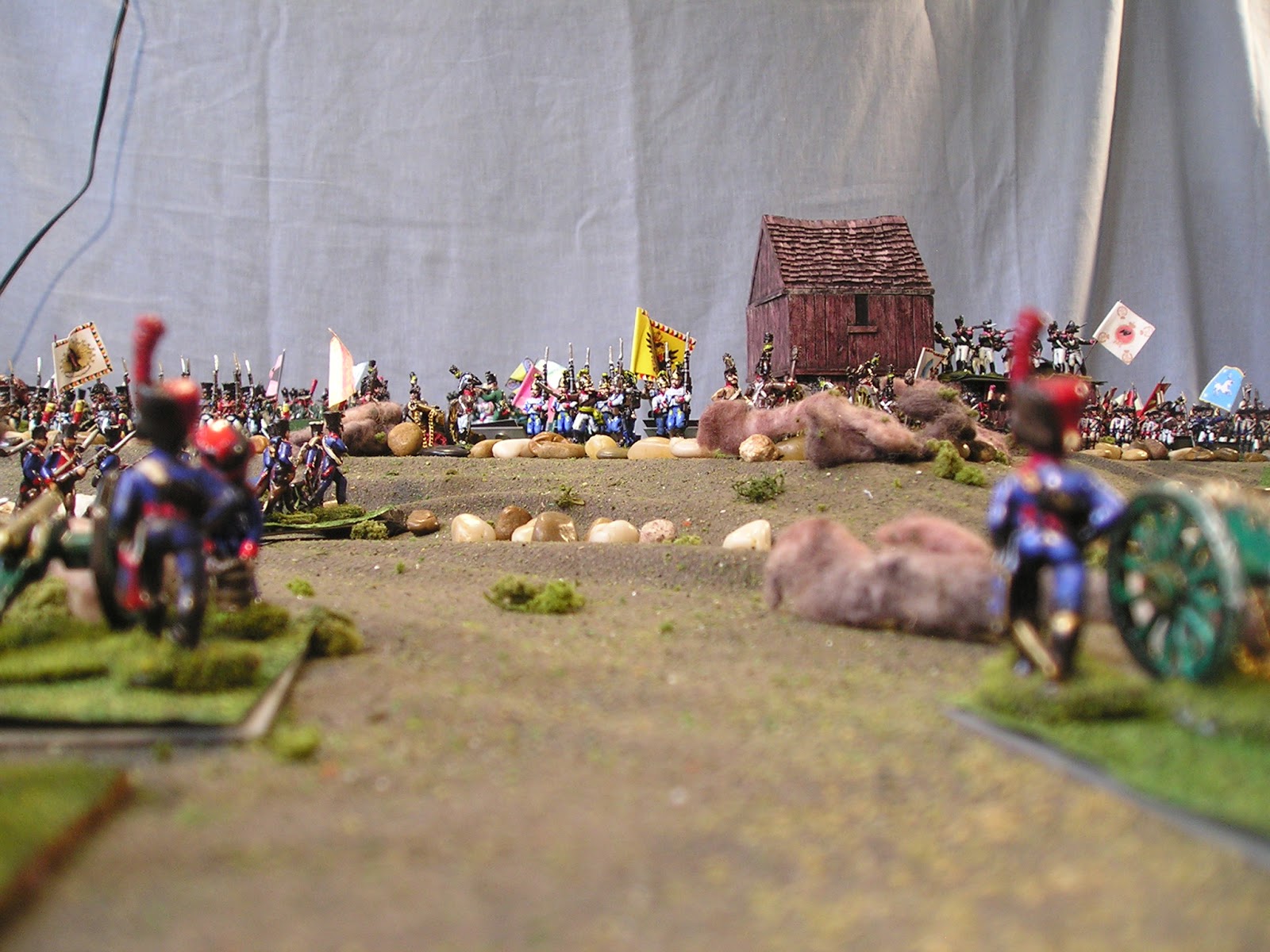
view from the French lines towards the Austrians lining the ridge
Again I was using the dark cloth table covering, with the stones as before to delineate the hill top and bottom slopes.

We made use of the tech at hand and had the French team go into a break out 'room' (digital) to make their plan so that the Allied commanders were 'in the dark'.

Then both sides did their orders maps as required by SHAKO II rules:

Allied map was dead simple - save for the Guard which was explained to my tech leader, Alex

The French map was more detailed and covered the situation really quite well
The missing Russian guard portion called for the Guard to arrive on turn 2 (same as the Russian foot division, to the north) and pass south of Pratzen and move past the point of the plateau into the hollow to the west of Pratzen.  With a turn 2 arrival and a slow march, this would put the division 'point' of the arrow on or about turn 5.

turn 3 overview

The French Guard columns were storming the plateau with Italian guard to the south side of the formation

Russians and Austrians were now becoming intermingled as they struggled to hold the ridge against D'Erlon's division in the north of Pratzen

D'Erlon's view

massive artillery formations were present from both sides, with the French having the Imperial Guard foot and Horse Batteries

the gap between d'Erlon's division and the Guard

Guard on advance with Pratzen town in the distance

French Guard Commander Bessier (represented on the white horse - my own sculpt of Eugene de Beauharnais)

not to be outdone the Russian Imperial Guard under Grand Duke Constantine was now assembling behind their own horse batteries supported by Austrian Horse batteries!
the supreme moment came in turn 5, 13h00 as the French Guard executed an excellent combined arms assault just south of Pratzen hitting the Russian Pavlov Grenadier Guards with both the French Grenadier Guard a Pied and the Grenadier Guard a Cheval at the same time, indeed a turn earlier the Guard Foot Artillery had injured this unit as it moved forward.

game ended after 5 very active turns
The French had a toe hold, and if you look to the top right of the flash photo with troops in it you can see the Allied Imperial Headquarters behind Pratzen (now on fire) and the French Grenadier foot and horse are BOTH in easy range of this vital target.  On turn 6 without doubt the Allied Grand Headquarters would have been over-run, leaving the Allied armies leaderless and at -1 to all rolls for continued survival.

It is hard to say if the French could have claimed to have achieved the same results as Bonaparte, who was reported to have been sighting artillery on the south slopes of the plateau at 14h00.

All in all a great game, had a wonderful time chatting with Dan-O and Thomas after the battle and have some new ideas on how to make our next tabletop broadcast even better.

We are certain to have at least two more opportunities over the next few months as the separation instructions and needs will keep us away from face-to-face for a while longer yet.  Watch here and on facebook for future game events.


Wednesday, May 06, 2020

LIVE GAME Pratzen Plateau - May 16, 2020

You could command a division of French or Austrians or Russians at the Pratzen Plateau, a game in 28mm of the1805 Battle of Austerlitz, planned for May 16, 2020.

view the game on twitch.tv/murdocksmarauders

Contact me direct via email for the active player code or jump onto https://www.twitch.tv/murdocksmarauders/ starting at 11 am Saturday 16 May 2020.


Monday, May 04, 2020

Wooden Ships - repairs completed

With time suddenly available, as I was not able to get enough stiff wire for the Scottish pikes, I decided to tackle a ship repair project for some 18th Century ships that I inherited from Jeff.

the finished product in a new box, with new sheet steel plates on the bottoms and placed on neodymium magnets inside the box

they arrived in a totally mangled and mixed condition

in progress of re-setting masts and sails
Now I have 25 of these ships, a mix of 100 gun, 74 gun and down to 20 gun ships.

So perhaps it might be time to dig out the old Wooden Ships and Iron Men?

... gonna have to make preparations for the game plan on May 16th while cleaning and prepping the Scottish and the Pirate Ships!

Sunday, May 03, 2020

Workbench: WH40K for my son

I had a little commission from my eldest son to do up some WH40K units for him.

some sort of battle angels - I was suggested Athena like uniforms - did them in white jumpsuits and silvery wings/jetpacks

the newbies

flame thrower crew

two veterans (one similar to the battle angels)

Command group with a flag bearer and an engineer

It was a fun little diversion to go into the sci fi world again.

Next up, looks like more ECW, likely Scots are looking ready to field some pike & shotte units, while the border horse is also ready to drop on the painting table.

Some rumblings of fantasy stuff are still out there with the Nanaimo crew, so I may be going through the storage and seeing what is there in detail.

Saturday, April 25, 2020

Blucher AAR - solo

A wonderful solo game has been posted HERE at Storm of Steel.

the 6mm minis on special shaped bases along with numbered and named tags that he uses on the tabletop


Blucher is the final game version of what I use Fast Play Grande Armee.

my own FPGA bases at Ath with the same SP indication system on the bases

Thursday, April 23, 2020

ECW Campaign - War in the West - Scenario #1 Glastonbury

Going against the grain of history, Parliament had won at Stratton, yet due to the difficult nature of the troops, the bulk were untrained raw and the few veterans had been bloodied and not paid for weeks, so Stamford decided upon a safer course of action and withdrew with the guns and what good order troops would still follow him across Devon to Exeter.

Hopton, meanwhile was able to withdraw in good order from Stratton and still hold on to the bulk of the Cornish forces.

On May 14 Hopton read orders from the King that he was to march and meet with forces under Prince Maurice that had been dispatched to the west from Oxford.

Royalists assemble in the muddy fields near Glastonbury
 It was a striking tribute to Hopton's hold over his Cornish troops that they apparently made no serious murmur about the prospect of marching far from their native county.  The Royalist forces crossed the Tamar on Whit Sunday (21 May) heading first from Okehampton, they were there joined by Grenville's regiment [and the new conscripts he had mustered].  Approaching Exeter, Hopton once again summoned the town to surrender but on its expected defiance wasted no time in attempting to take it.  Leaving two companies of foot and one of dragoons at Columb St John, three miles to the east of Exeter, in order to contain the garrison, the Royalists continued their eastward march and on 4 June linked up with Hertford and Prince Maurice at Chard.

The independent existence of the Cornish Army was at an end, and this union with the wider Royalist world inevitable led to changes.  The most immediate was a step down in authority by the Cornish Army commanders, thought he resulting command structure was hardly more clear-cut than previously.  Hertford was General.  His role was, however, fairly limited, partly through his personal inclinations and limitations but also because of the forceful personality of his Lieutenant General, and second-in-command, Prince Maurice.  Hopton and his officers had to be slotted into this new arrangement, and Sir Ralph, as 'Field Marshal General', became effectively third in command of the united forces.  Hopton did not complain of this arrangement in his memoirs, but he deplored the effects which joining the forces from Oxford had on the discipline of his own troops.  He was described by his friend, Clarendon, as 'a man superior to any temptation, and abhorred enough the license and levities with which he saw too many corrupted.'  Nevertheless, while he had partly succeeded in keeping his Cornish troops in check, he found the situation very different among the Oxford horse: 'there began the disorder of the horse visibly to break in upon the prosperity of the public proceedings . . . the Generals were never able to repress the extravagant disorder of the horse to the ruin and discomposure of all.'
It is only fair to add the comments about he Cornish made be Captain Richard Atkyins of Prince Maurice's Regiment of Horse:
... the Cornish foot could not well brook our horse (especially when we were drawn up upon corn) but they would many times let fly at us: these were the very best foot I ever saw, for marching and fighting; but so mutinous withal, that nothing but an alarm could keep them from falling foul of their officers.
 Atkyns confirms Hopton's view of the mutinous nature of the Cornish infantry, but it is at least possible that some of the animosity resulted from the natural jealousy felt by the foot soldier towards the advantages held by a horseman when it came to obtaining loot.  Atkyns says as much when he recounts an incident which occurred shortly after the armies joined; "[While] observing a hole in an elder hedge, I put in my hand and took out a bag of money; which if our foot had espied(who were also upon the search) they had certainly deprived me of both it and my life."

For the moment, however, animosities were diminished by action.  Parliamentarian forces in Somerset were in some disarray -- no match for the united Royalist army.  Parliament troops initially in Somerset were 1000 horse, 400 foot and some 2000 Somerset Trained Bands.  Also on his way was Sir William Waller, the Parliamentarian commander who had recently made a name for himself with a string of victories along the Welsh border.  He was, however, held up for a week in Gloucester, trying to obtain pay for his troops, and did not reach Bristol until 6 June.  Even when he arrived in Bath two days later, he would spend the next three weeks organizing his forces.
 ~ from The Civil War in the South-West by John Barratt pp. 38-40

So now the stage was set for Glastonbury, a Cornish foot and Oxford horse force was to face off against the Parliamentary forces under Waller ...

After some maneuvering Waller found that his army needed to withdraw, and sensing an opportunity Maurice 'pounced'.

opening of the battle, Royalists (to the lower left) must get three units off the north end of the field (upper right) - to stop them a rear-guard must hold off the Royalists for more than 12 turns

Royalist foot man the hedges and the Royalist horse prepare to dash through any holes in the Parliamentary lines

only newly recruited (wavering) troops are available for this first rear-guard action, though one trained force holds a flank position (red flag)

Alexander Popham is in command for Parliament

the hedges were crammed with pike and shot to hold off as long as possible

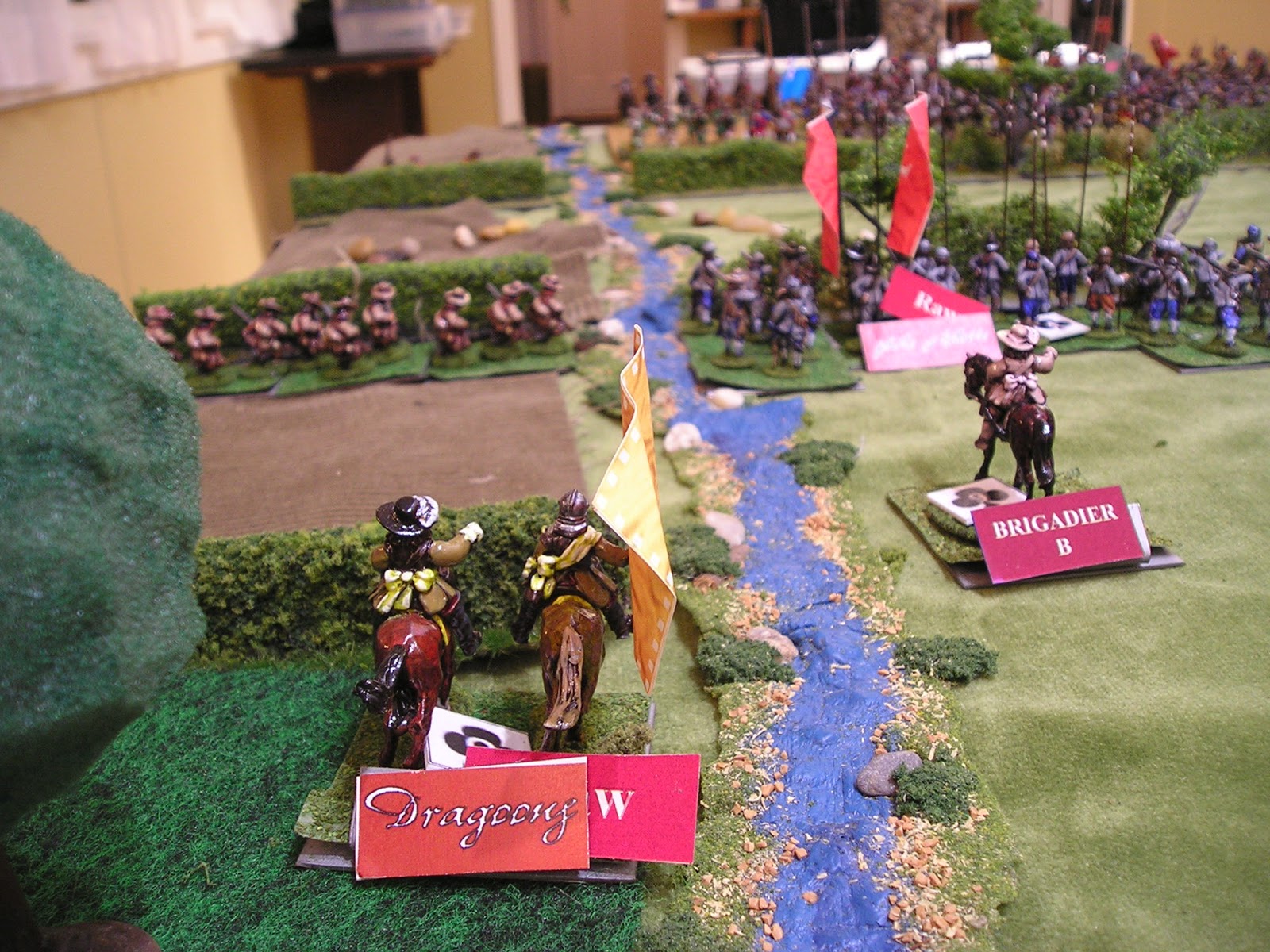
dragoons hid along a flank to make good a delaying action

Popham had a horse line to back up these foot and no plans to withdraw, forcing the Royalists to fight for any ground
(the pebbles you see are used to indicate ditches that cross the muddy fields)
the action began immediately with volley fire

exchanging shot for shot with each side

Parliament were lucky with saving throws

dragoons on the west side of the fields also had a ditch and hedge forming a natural 'trench' to fire from

Royalist musketry did not slow

though many casualties did mound up for the Royalist (Cornish) foot
Field view on turn 4

the center Parliamentary foot had fled the field (wavering unit)

while Royalists continued to pour on the musket fire
Field at turn 7

a wavering raw unit of foot had managed to continue to stand under the Royalist fire

While Parliamentary horse made ready to attack

the last of the pike and shot units melted from casualties
turn 10 saw an amazing charge-counter-charge with the Prince Maurice's Lifeguard horse first being driven back

then completely failing in a charge
the combat die rolls - Royalist on left :: Parliament on right

the morale test for Prince Maurice's Lifeguard (flee off the table!)
Watching the Lifeguard of the Prince did not go well for the rest of the Royalist army, as the Cornish foot might have realized they were going to be sacrificed so that the Oxford horse could make good an escape?

turn 12, when it was determined that no Royalist units could expect to cross the north end of the field in time as the horse were all spent

Parliamentary dragoons continued to lurk in the west

Royalist horse could no longer advance on the enemy as too many of them were broken or shaken morale

Cornish foot were angered by the failure of the Oxford horse to gain the ground

Parliament forces that escaped from the field intact.
Game was played out February 9, 2020

The cottage game location seen in wider view
Campaign is now in a holding pattern, until the wider medical conditions change.