Fast Play Grand Armee Battle of GorodetschnaOne Week ago I launched into examining the Fast Play Grand Armee rules in detail with some troops and a historical battle from 1812, Gorodetschna was the one active engagement between the Austrians and Russians during the 1812 campaign of Napoleon.
For FPGA I am impressed enough with the system to give it another go for certain.
I liked the speedy flow of the turn with strategic decisions coming for the commanders right away. Each turn the commanders are called upon to roll 'command dice' and they may use these to command troops or influence outcomes of things like initiative or morale of the troops around them. The 'initiative' die roll has more influence than might be brought to mind.
Other items I like from the FPGA are the 'pulses' system that makes each turn have an unpredictable amount of movements in it, the turns are still even in that each player may have opportunity to move within the rules - and - both sides do not know if this 'pulse' will be the end of turn or not... This makes the decision making process more complicated and introduces potential for unexpected.
The commands are not 'instantly' under control and they may make unexpected actions, the commander may influence these by using the 'command dice' that are rolled for at the start of each turn, and there are still many instances that loss of command or unexpected actions may happen. In the Gorodetschna battle that I did, these unexpected actions did happen, some that went well for the side that had them come up and some that did not.
In my battle I started with the positions of the troops as identified
here.
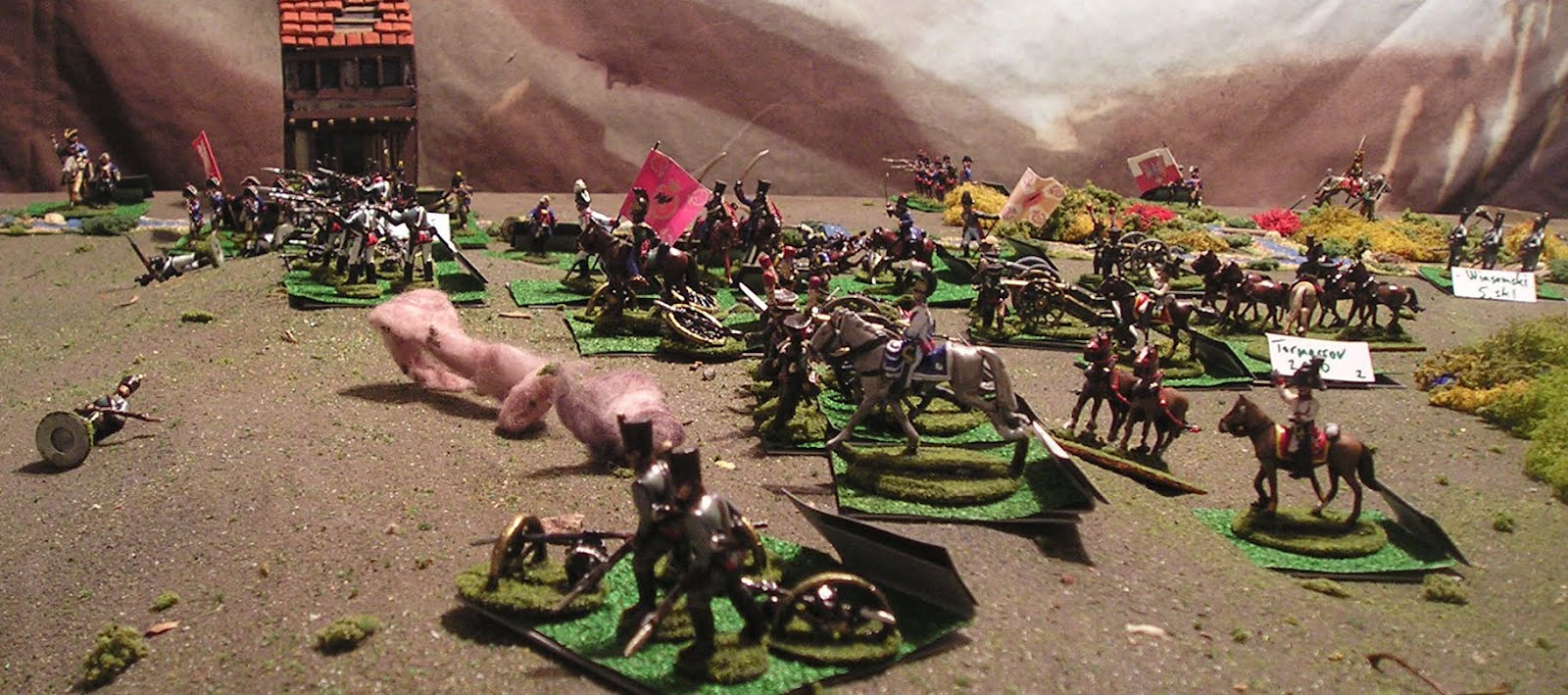
The opening map ended up looking like this.

Once again I was able to bring my sky-cloth into action for backdrop of the pictures.
As I was running the game solo, I chose to follow the general historical plans of the two commanders. The Austrians were deployed second with more freedom to re-deploy as I had rated Schwarzenberg as a 3 CD (Command Dice) leader and the Russian Tormassov as a 2 CD commander.
Straight way things changed from history, first the battle started at "Late Afternoon" meaning that only 2 full 'turns' would happen before the end of the day ... I had thought this would make for a near historical 2-day battle, though I did see that the Austrians would have to push hard to get into a flanking position on the Russian Columns.
Next the Russians had the ultimate in bad luck ... Tormassov rolled a "2" (snake eyes) for his CDs. This meant that I would have to use the wing commanders to 'grab the lapels' of their subordinates to get the columns moving. And grab them they did over the course of the day.
The Austrians chose to screen off the powerful artillery and massed columns with two mixed divisions and shift all the others to the west in order to cross the river and move into the Russian Left.

The Mixed Brigades used by the Austrians mainly, were a great benefit here as they had superior skirmishing ability and this had the effect of breaking up the Russian brigades that they were used against. Here the first lesson of FPGA came into understanding. If you win the initiative you get to use skirmishers ... if you do not, then you do not. The early success of the Austrians here was critical in permitting them the movement time, as the skirmishers held off the head of the Russian column. Without the initiative advantage the Austrians would not have been able to do their re-positioning without greater screening forces.
Then the Cavalry broke out into the flank ... here I think I may have missed some of the Russian opportunity to disengage from the conflict, however had they done so then the flank would likely have collapsed completely. As it was, due to the lack of CDs for the Russians the flank was forced to stand still for the most part.

While the Austrian Cavalry then artillery started to move into the open space available.
Schwarzenberg did not get everything to go his way though, for even with initiative, the distance to the flank was beyond his command range (20") and this cut the CDs that could be sent to the flank, thus with the low dice roll the flank commander,von Funck, was obliged to simply stand still and "Hold" while at least his artillery could drive forward his Division could not.

Now the FPGA 'pulse' system came into action, the first turn ended with only one pulse. This was good for the Austrian flank screening forces as I was forced to use the Division commander on the extreme flank and abandon 1/2 of his command in the swampy ground at nearly point blank range to the massed Russian guns.

The second turn was just as bad as the first for Tormassov as he rolled another snake eyes for CDs

Once again the Austrians were able to use their skirmish power, while the Russians were not, then in movement again the Austrians were free to roam while the "grabbing of lapels" was needed by Russian wing commanders. All I can say is that I was glad to have some extra Russian commanders that had 'superiority' and could do the work of keeping the column moving, for without them the battle would have been lost long before even getting to the shooting parts!
Speaking of shooing, I finally got into the action with Frimont's division of cavalry, I saw that a way must be cleared or there would never be room to deploy the Austrian column, while the Saxons could break out on the far flank there would just not be room for both if the Russians under Lambert were free to roam, so I threw in everyone including Frimont to get the job done fast. FPGA has rules for including command ability and accounting for the commanders risking their lives. In this case the Russians were only pushed back and it cost Frimont his life!


Lambert then counter attacked, I also threw Lambert in here to motivate the attack, I shall admit to missing the opportunity for the Austrian cavalry to evade (as I did not make that choice), presumably they could have fled from the Russian Cavalry before becoming embroiled then having Russian Infantry press into the flank of that mass of cavalry fighting.

Meanwhile the 'grabbing of lapels' continued as this turn was to have a second 'pulse', this time the Russians had no CDs left and again I was thankful for the extra Wing Commanders, sadly one of these commanders went off his head (or so I thought at the time) and flew into a rage (rolling 12 for his command = ATTACK). Suddenly I had to throw three brigades forward as fast as possible towards a line of Austrian Artillery that was getting set up! It was a bold move, as the next turn was to tell. The troops were too far away to reach the gun line, yet the move had let them close to point blank range on the guns ... if there was another pulse ...
Unfortunately for the Russians there was not to be another pulse, at least the CDs for Tormassov came up a more normal "8" and the Austrians only got "9" so the final turn of the day (#7 in a summer time frame) was going to be very close indeed.
Both commanders used all their CDs in the first pulse, wanting to make certain to get the job done now if at all possible!

I had deployed one Russian Division on the riverbank and maneuvered the batteries to take action where the Austrians were crossing. I did miss one section of FPGA where if a brigade is out of command range they may not fire and are 'vulnerable' ... I think the Austrian flank force would have moved in to assault this covering force upon seeing the troops moving in such an uncertain way...
Austrian command was not going all swimmingly either ...

Some of their forces were not getting across the river with the support needed.
While the more mobile, well suddenly more, Russians were able to break into the extreme flank with dragoons.

Now is when the rush move of the Russian commander "grabbing the lapels" of the earlier turn proved the worth. The brigades had taken casualties, however due to the sudden immobility (due to the low roll of the Austrian Division commander)

these Russians then raced forward and charged the now unsupported guns. While one battery escaped the other two were not so lucky. The one moment of hesitation (the 'hold' from the Austrian commander) combined with the earlier (apparently mad) attack order from the Russian Wing commander had brought this opportunity about, something that could not have been really planned. While I was at first unhappy about each part, upon review I found them both very plausible.

Now the battle turned a most interesting corner, again there were more than one 'pulse' to the turn. This time neither commander had any remaining CDs ... so what was to come would be more open to the luck of the subordinate commanders. By now the Russians had broken out the Wing Commanders, so 'grabbing the lapels' would not happen.


Still the Austrian flank force was held in place, holding up nearly twice the number of Russians on the opposite side of the river.

Now the battle line, as had happened on the second day of the historical battle could be seen, the difference was that the Austrians were not fully deployed and they had lost 2/3rds of their artillery.
The Saxons under Reynier had managed to push into the Russian left flank, they were not unchallenged now though...


For Schwarzenberg, the situation was grim. There were no reserves to keep pushing forward and there nw existed the risk that a Russian Division could break across the river on his far right flank.

This final turn was to have one more 'pulse' and incredible three in a row, where artillery would start to take a great toll, for now both lines had batteries in position to punish each other ... what a fantastic nearly night-time barrage this would have been!

This third 'pulse' meant more movement without help from commanders CDs to get effective control. Thankfully neither of the 'flank' covering forces rolled the wild high dice.

The Austrians were close to their morale level and not interested in closing to combat, so the barrage was all they took action on. For the Russians, the leading divisions were badly mauled and they too were not keen to loose too many more men, late in the day there was good chance to get a great effect on a second day so the artillery barrage was all that was done.
There were no more pulses, yet the damage was done, for the last move of the day called for one more army break check, this time BOTH SIDES failed. The Austrians failed by a larger margin than the Russians for certain, yet they would both withdraw from the field. For this re-fight of Gorodetchna, only the 30th of July was needed to end the battle and the losses to the Austrians were truly painful at 3 Cavalry Brigades, One Mixed and One Infantry Brigade and two heavy batteries destroyed; while the Russians would have only lost one Cavalry Brigade and one heavy battery. Ultimately there were many infantry losses (in the taking of the Austrian batteries) though no battalions were broken.

Tactically the battle was a draw, in the strategic situation the Austrians were definitely the looser.
I can certainly see the appeal of handling forces in this way, the Brigade is much more the smallest unit that an army commander would care about ... training would take care of the rest, such things like squares and mixed formations in action. I can see me running more games using this system and having some 6mm troops on the stands would make the 'look' even better.




.jpg)


.JPG)