Friday, March 29, 2013

Greek Gods

As part of fundraising efforts at Spring Mysteries Festival 2013, I have painted a set of the Greek Gods by Foundry.

Hera & Zeus

Hermes, Athena, Poseidon, Hera, Zeus, Persephone, Hades, Hecate, Ares, Aphrodite (front row); Artemis, Rhea, Hephaestus, Demeter, Pan, Apollo, Dionysus, Hestia (back row)

Some close-ups of Poseidon, Zeus & Hades (top); Artemis, Pan, Ares and Athena (bottom)
They were fun to paint, now to see what excitement they can generate in auction for a good cause.

Monday, March 25, 2013

A sneak peek

any guesses?
A project that has been some months in the making is now coming to completion.

Here is but a sneak peek into the work in progress.

I shall have the lot done within 24 hours, and I must, as they are to travel with me to the Spring Mysteries Festival as part of the fundraising efforts.

I depart in two days time, will be back with you all and sharing the full photos after the trip.

Friday, March 22, 2013

Austrian Napoleonic Uniforms - Army of Infantry on parade

With the completion of the foot, I decided to roll out the whole of the Kaiserlicks that I have so far ...

320 minis in all so far wearing the white coats of Austria

The troops are on fender washers, then stuck to metal bases with magnets.  A strip of grass paper is between the man and the magnet.

I have brigaded the troops by helmet styles for the photo

It is only when you have lots of them on the table that the really cool effects get seen

some detail of the helmet wearing Austrian infantry of early 1800's
A greatly expanded command staff, including the sky blue coated engineer seen with the commander here

Okay enough looking back, onto the cavalry of Austria, Prussia & France.

Thursday, March 21, 2013

Austrian Napoleonic Uniforms Infantry & Artillery complete

Latest additions to the Austrian force
The flocking was done last night, today offered an opportunity to get the troops out onto a table and get some proper photographs.

The force consisted of 5 battalions of line (one Hungarian - in the blue pants) and one battalion of grenadiers plus 8 artillery stands each with three gunners.  To command the lot were four foot officers, an engineer and a mounted officer (modified with epaulettes and a medal - green stuff is so much fun!)

Missing in the photo shoot was the one fieldworks basket that was done.  I now have another to go with it that is on the painting table, so I will do up a shot or two once I have at least a matched pair.

All minis painted from March 2-19, 2013.

Monday, March 18, 2013

Austrian Napoleonic Uniforms Infantry & Artillery WIP 6

Infantry & Artillery WIP - out in sun awaiting gloss coat
Nearing the finish line with this load of white coats.

Today the metallic layer was done and details and final highlights.

I paused to get a photo of the lot out in the sunshine this afternoon, just before the gloss coating spray was done.

You can see the 'sticks' that I mount the mini to for handling during the painting process, I put them on with a watered down white glue (like the children use in primary school for paper)  so that they will pop off the sticks later.

This body of troops now rounds out the Austrian infantry.

Up next on the Napoleonic troops list are loads of cavalry, for Austria, Prussia and some French Allies.

Along the way I will also have some Imperial Guard foot artillerymen and a few extra horse artillery for the Guard also.

the whole lot of Austrians just before the gloss spray in the sunshine

Sunday, March 17, 2013

Austrian Napoleonic Uniforms Infantry & Artillery WIP 5

Austrians in shako work in progress
The ink layers are all on now, actually damp still in the shots.

The red cuffs are also done, as is the red stripe on the flag poles.

Now to let all set overnight.

Next up the faces and hands.  Yellow, blue and green collars & cuffs.  Finally the metallic parts.

Friday, March 15, 2013

Austrian Napoleonic Uniforms Infantry & Artillery WIP 4

Austrian foot & guns WIP
More progress on the whites this time, only the whites as time was pressed.

(something also happened with my camera - the foreground was really out of focus on the bottom shot)

Now the flagpoles are all ready to take on the red, yellow & black stripes.

Inks for the artillery go on tonight and have time to dry.

Big section of color work to do next with all the units getting their cuffs & collars.

Thursday, March 14, 2013

Austrian Napoleonic Uniforms - Infantry & Artillery WIP 3

Austrian Infantry & Artillery WIP
The Austrian Infantry, in shako, and artillery batteries continues to make progress.

this stage has the 'middle' layer color in place.

As you can see the pants of the artillerymen start to take on more shape and stand out from the doe brown shell jackets they are wearing.

Again the artillery still not looking so great, but then the inking stage is still a few nights away.

Tuesday, March 12, 2013

Austrian Napoleonic Uniforms - Infantry & Artillery WIP 2

Work in progress
The work continues on the Austrian brigades and batteries.

Now the block colors are all in I shall be moving to a smaller brush to lay on the 'mid-tones' of lighter blue and brown.

The artillery I shall be doing a new approach that I have read about involving inks.

Monday, March 11, 2013

Austrian Napoleonic Uniforms Infantry & Artillery WIP #1

Base coated on their panting sticks for handling
I always mount the minis onto fender washers now, so that they will be ferrous-magnetic and stick to the magnets in my basing system.  The advantage to this is that the minis are also more stable for single use, as has been called for time to time by my boys (who like the Grant style games better on the dining room table).

The Prince August guns take some time to cast right, yet once turned out they are great
The assembly line take a day or two to set up, yet once done everything paints faster, no more dropped minis due to cramped hands holding the bases.

field works basket in progress
I finished the green stuff basket and mounted it for painting in this lot ... if it works well then I may make up another 11 or so of them to make an even dozen.

Sunday, March 10, 2013

Austrian Napoleonic Infantry and Artillery

print after R. von Ottenfeld
I have begun the work on another 100+ Austrian foot troops and 8 Artillery batteries.

Completion of these battalions will round out the foot troops I need for the Kaiserlicks.

Just the bare metal
The officers in this group being painted will include an engineering officer, just for the difference as most of the Austrian uniforms are white.

I have also taken to building a fieldwork basket from the spare green stuff as I modified the minis and stabilized the bases, there was always a bit left over, so I cut up some wire and set up the basket works.

Saturday, March 09, 2013

Some Pike and Shotte

Diversions, lots of them appear from time to time.

I have been going over the 'pile o lead' and re-encountered some things that had been under planning and/or consideration.

This post is to focus on some English Civil War (ECW) pike & shot, horse, and Scots that I have re-encountered.  They were packed in Essesx, Dixon and Hinchliffe boxes, but I am reasonably sure they are not from those manufacturers.  I share some quick photos (a little out of focus on one) to help in the identification process.

The selection of pike and shot with an officer and drummer

The horse, with an armored torso and non, 4 heads and arms including a trumpeter

The Scots, including more pike and some different riders (no arms/heads swapping needed)
The peasants, clearly they are from a different manufacturer as they are smaller, come with shields and empty hands for holding spears or pikes (or could be used as artillerymen?)

Maybe those of you out in the internet land that recognize these blokes could leave a comment about them?

Monday, March 04, 2013

Russian victory in 1812

Russian losses over the same period were also far from light; it is estimated that at least 150,000 perished from all causes, and at least twice as manymore must have been crippled by wounds or frostbite.  An incalculable number of Russian civilians must also have suffered during the seven months of bitter fighting.  However, by the end of the year, the Tsar's forces enjoyed the great advantage of a strategical victory over Napoleon with which to boos heir morale - the soil of Holy Russia was clear of the invader.

The French forces and people had no such compensation, If it were possible, France's allies had even less reason for comfort or complacency.

~ D. Chandler, The Campaigns of Napoleon, p. 853


Sunday, March 03, 2013

Failure of a giant

In the last analysis, Napoleon's defeat can be explained in terms of two circumstances.  First, a general decline in the quality of his generalship, shown first in the lack of energy which led to poor supervision of subordinates and repeated failure to intervene personally at the decisive point (as had ever been his practice in the years of his prime); this is also reflected in growing indulgence in wishful thinking concerning the military capabilities of his troops (which he persistently overestimated) and the character of the Tsar (which he consistently underestimated).  The second circumstance was the sheer size of the enterprise he attempted to undertake; it is doubtful whether any soldier in history would have achieved a larger measure of success, both in preparatory and executive phases under the military conditions of 1812.  But in the words of philosopher Montaigne, quoted by the American historian, Dodge:  "Great and distant enterprises perish from the very magnitude of the preparations made to ensure their success."  The Problems of space, time and distance proved too great for even one of the greatest military minds that has ever existed, but it was the failure of a giant surrounded by pygmies.

~ D. Chandler, The Campaigns of Napoleon, p. 861.

Friday, February 22, 2013

SCRUD - Simple Combat Resolution Using Dice


SCRUD
Simple     Combat     Resolution     Using     Dice
Methodology / Explanation
1.      Throw one die for every unit present in the action.
2.      Line up one sides dice in order of highest first,
3.      Line up the other sides beside them.
4.      Compare each pair of dice. Highest v. highest, then next highest pair so on... 
5.      Same score on both dice is a STAND-OFF,
6.      Difference of 1 means Loser RECOILS.
7.      Difference of 2 means loser RETIRES.
8.      Difference of 3 means 1oser RETREATS.
9.      Difference of 4 means loser ROUTS.

Note: Any dice left over usually won't count, eg. If 8 die v. 6 then the odd 2 can be ignored as by definition they must be the lowest 2 scores and lots of reasons can be advanced to show why they would have had no influence on the battle.
This mechanism can be expanded to make it a more accurate combat resolution.
(Don’t make it too complex or you will spoil the whole concept.)

Adding Other Factors
1.    The addition of any UNIT COMBAT VALUES (such as for example, +2 for Elite; +1 for Veteran and -1 for Raw troops) will modify the dice throws.
2.    (This can be done by simply turning the die over. (eg a 3 becomes a 4)
3.    IN THIS CASE IT WILL BE IMPORTANT TO NOMINATE THE THROWS (EG These 2 die have a +2, etc.)
4.    IT MAY ALSO BE USEFUL TO DIFFERENTIATE BETWEEN HORSE AND FOOT. “These 2 die are
the Cavalry.” Then throw them and turn them if appropriate.
5.    When modifying the dice It will be assumed that 6 is the MAX score and 1 the lowest. So a nominated +2 which is then thrown an a 6 stays a 6. (Tough luck). In the same way a nominated -1 which is thrown as a l stays a 1.
6.    There could also be OTHER +/- FACTORS such as TERRAIN ADVANTAGES, which side is ATTACKING / DEFENDING, MORALE and LEADERSHIP etc. But these will tend to be better reflected By the Umpire using IMP [inherent Military Probability). ie using his Umpire skills / knowledge to 'fiddle' the COMBAT RESULTS.
7.      However in a Campaign some aspects, such as FATIGUE due to FORCED NARCHES may / will have to be built in as +/- factors at the dice throwing stage.

EXAMPLE SITUATION: The ATTACKER has 8 units of Foot & 2 of Horse. (1 of the Foot units is Elite (+2); 2 are Veteran (+1); 4 are Experienced (0); 1 Foot is Raw (-1): the Horse are both experienced (0).)
THE DEFENDER has 6 units of Foot & 2 of Horse. (3 Foot are Veteran (+1), the rest are Experienced (0). The Horse are Experienced (0).)

ATTACKERS Dice Foot - 4  4  2  6  1  2  1  2 Horse –  1  4
FACTORS              +2 +1 +1  0  0  0  0 -1          0  0
Dice after adjusting  6  5  3  6  1  2  1  1          1  4

DEFENDERS Dice Foot - 5  3  1  2  1  3       Horse –  3  5
FACTORS              +1 +1 +1  0  0  0                0  0
Dice after adjusting  6  4  2  2  1  3                3  5

Dice in descending value
ATTACKER      Foot      6  6  5  3  2  1  1  1 Horse -  4  1
DEFENDER      Foot      6  4  3  2  2  1     Horse -  5  3

Difference-Defender   = -2 -2 -1  =  =                +1 +2

RESULTS ARE - Defenders Foot 3 Stand-offs; I Recoil & 2 Retire. The Defenders Horse drive off the Attacking Horse, (A further dice throw then showed that the Defenders Horse did not pursue, staying on the battlefield with it’s Foot units.

Umpire Analysis – The Defenders Foot have been beaten and have been driven from their position. The presence of their Horse allows their withdrawal from the field to be conducted in reasonable order so their casualties remain moderate.

Special thanks to Mike Irvin for the system details. 

Edit Feb 22 added:
Great resource for the original vision of SCRUD: Matrix Games

Saturday, February 16, 2013

Second Upper Spree - Corbineau's Victory

For the Campaign of Nations play test, there remained one last potential field battle.

A rather complex one with two French forces converging on a Russo-Swedish Allied one.

Pozzo di Borgo and Voronsov commanding for the Russo-Swedish Allied forces
 I used Fast Play Grand Armee (click on the link to go to the free rules online) to run the game, with a separate 'start time roll' for each of the Attacking French forces.  This was done to simulate the difficulty in co-ordination of widely disbursed forces that have no direct line of communication between them.  The rolls came up 5 for the north force, XIV and III Cav Corps under Corbineau and 6 for Oudinot's XII Corps.

This could make sense, as Corbineau would have to assemble the foot and would not have had a clear picture of the ground.  Also Oudinot had just retreated away from a battle on the same ground, so there would be plenty of shadowing Cossacks in the woods to hamper his return approach to the battlefield.

It did mean that the Russians could concentrate on the north force, hamming them to see if they would break before Oudinot could arrive, also that there would be only limited time in the 'first day' of battle for the French to get their victory.

Deployment, north side of the Spree in the foreground right with III Cav Corps and XIV Corps
St-Cyr was placed in battlefield command and chose to mass the artillery into a grand battery on his right.  III Cav  Corps was on the left, with a column of conscripts all set to run up the road in the center, backed up by Chasseurs from III Cav.

French deployment on the north bank of the Spree

 The Russians now also had two more foot batteries, having taken them from the Polish corps two days before.  The massed these with their huge position batteries of 20-pounders to sweep the river crossing and beyond.

Russo-Swedish deployment on the South side of the Spree

 Right from the outset the French gained initiative, though the powerful massed artillery proved too much for the conscripts, an entire brigade simply vanished in a cloud of gunpowder from the first moments of the advance.  The Russians kept up a steady flow of Hussars and Cossacks to keep throwing back any that attempted to cross the river.

Turn 5 pulse 2 or about 16h30 - French are still not across the Spree

 The French III Cav Corps, ran their horse artillery up to the river's edge and began pounding Russian horse on the opposite bank.

French Horse batteries pounding out shot at Russian Hussars
Cossacks seemed to be everywhere at once, screening the massed artillery from counter-battery fire and striking at French brigades that were in the bridgehead ...

The chaotic scene at the bridgehead
St-Cyr had sent off a division of light cavalry from III Cav Corps to flank the Russian position ... so far they had not emerged from the woods.

French QG of Marshal St-Cyr, behind him is Baron Corbineau

Arrighi, commanding III Cav Corps was having some command challenges of his own.

French III Cavalry Corps Command
The Dragoons under his command, had been set as reserve and they were ordered to move up - in preparation to exploit any opening at the bridgehead.  Their commander, Defrance, chose to withdraw them back to beyond their starting position.  Indeed, had the Russians and troops closer to the river then these Dragoons may have left the field entirely!  One of the interesting aspects of Fast Play Grand Armee is that a division may suddenly roll a 2-4 (on 2d6) and you will find yourself having to scramble to make up the situation, in this case it was not so bad.

French Dragoons nearly decided to withdraw entirely ...
Turn 5 done, only 2 pulses - not so good for the Russians, as now Oudinot was to start arriving to the south and they were going to be facing a crossfire on a strategic level!

The Swedish cavalry began to flex their muscle now, charging immediately at the Frenchmen arriving with Oudinot, sending a contingent of Saxons scurrying for cover in the forest.

17h00 Turn 6 pulse 1, now Oudinot was arriving.

Defrance had been turned around and was now in column of brigades , making for the bridgehead.

French heavy cavalry move back into the bridgehead
French artillery was still being confounded by marauding Cossacks, screening the flank of their heavy artillery from counter-battery fire.

French artillery firing on cossacks
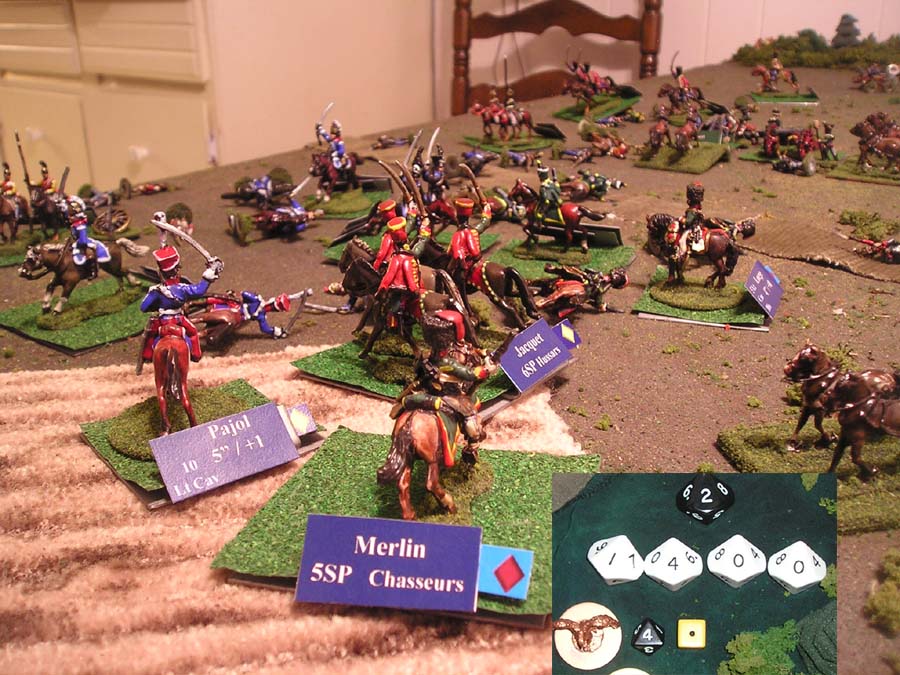
At the bridgehead itself, Pajol now had made a breakthrough, at last there were no more Cossacks to impede his breakout.

A breakthrough at the bridgehead by French Cavalry
The way was certainly not clear for the French though as Russian Cavalry was still active ... and taking fire from French Horse batteries on the north bank.

French Horse guns continue fire
Now though a critical event came ... the huge Position battery guns had to flee from a Conscript brigade!

Russian HQ watches as massed batteries are forced back by breakthrough infantry
In this same hour the flanking division of light horse made their appearance, though the commander chose to hold, this now clearly put the Russio-Swedish force in a three-sided box!

French Light Cavalry Division appears from the woods
The Swedish cavalry was now positioned to fall upon Oudinot's forces once they arrived ... this would not be an easy French victory!

Swedish cavalry massed for combat
Then, anti-climax, the turn ended.  This called for a potential for 'end of day' die roll.  Both rolled a "5" on 2d6.  This meant that the day of battle had ended.  This could represent rain showers falling or other major clouds that darkened the field too much for the commanders to effectively continue. The Russio-Swedish army was still in-tact, though somewhat battered.

Corbineau chose to pull back from the tenuous bridgehead and re-place some of his losses and round up some of the stragglers into the wounded brigades.

Oudinot would be able to fully deploy and engage the Allied army directly.

Once again a die roll to start the day's action would be done, this time only one roll though.  The roll was a "3", representing around noon.  Again this could be due to rains, or diplomacy - asking to have the Russians and or Swedes surrender; or it could have been continued Cossack harassment of Oudinot's Corps arriving though the night and morning; or indeed some combination of these and other factors.

Pozzo di Borgo, would have one more day to fight, this time Oudinot would be at point blank range.  The target was obvious - Oudinot's command headquarters.

Opening situation on DAY 2, turn 3 or about 12h00
On the north bank two divisions of light cavalry was ready to cross and press home on Russian artillery and cavalry.

French light cavalry would cross again on day 2 of the battle
The Russian lines were thinner than before, though still completely in tact for brigades, many were under strength from the exertions the day before.  Certainly there were fewer Cossacks to screen off the French guns.

Russio-Swedish Allied army - the 'meat' in the sandwich ...
Now there would be another Corps of French and German allied troops to hold off ... Oudinot was on the field in force.

Oudinot's XII Corps fully deployed for battle ...
The Russians knew that all would depend on who got to move first, so they threw in all that they could to take the initiative on this first pulse of turn 3 in day 2 - they won it 10 to 7!

Field of chaos, as XII Corps collapses

No time at all was wasted, the Swedish cavalry was cut loose totally, Saxons and other German allied troops were utterly destroyed in the charge of the Lifeguard Dragoons.  Lifeguard Cuirassier smashed though the center batteries of XII Corps and then on into the command headquarters of Oudinot himself.  He failed the survival roll - the headquarters was sent fleeing in all directions and Oudinot himself was dead!  Raglowich, commanding 29th Division was also cut down, this time by Swedish Hussars.  Only the cool reaction of Guilleminot and the 14th Division even kept what was left of XII Corps in the field.

Smashed remains of XII Corps as A Marshal and GdD are killed!
The bridgehead is successfully taken and now exploited
The bridgehead was stormed and exploited very well on the north bank, however the grand battery - seeing that Oudinot's force was to be cut to pieces, chose to withdraw from the riverbank?  (damn those "3"s!!!)

Arrighi and III Cav Corps were across the river in force now ... nothing could hold them back
Over on the flank facing the woods, the best escape route for the Russian horse, there was a different tale.  General Fournier and his 6 light cavalry Division were cut apart by Cossacks and Russian Hussars and lancers.  Only a remnant of one brigade remained in the area.  If only the Russians could keep alive, then maybe Corbineau's force could be driven off also?

Russian cavalry smash though to the woods line
It was not to be, turn 3 ended there and the new turn initiative was won by the French.

DAY 2 Turn 4 14h00
Corbineau wasted no more time with the delaying tactics of the Russians, this time the Russian Grenadiers were to be surrounded and crushed.  Over on the far flank, Swedish cavalry was forced to recover into new defensive positions, and the Russian horse were too far away to make any effectual difference in the outcome.

Breakout, now the bridgehead was open, the left flank was going to do envelopment  


Even with the artillery falling back, Corbineau still had a full Division in reserve, there were to be no mistakes on the field today.

French strategic reserve
French lancers and hussars broke out on the left flank and effected link up with the retreating elements of XII Corps.

flank envelopment was completed
The second half of the pulse was to be the end for the Russio-Swedish force.

taking too many losses, the Russio-Swedish for of Pozzo di Borgo's morale collapsed
The final acts were to be a series of French cavalry charges, that cut apart weak Russian or Swedish units.

French Cavalry charges

Swedish Lifeguard Dragoons fight off two brigades of lancers and hussars
Russian Dragoons rapidly re-deploying from the lift to right flank ... it was not to be fast enough.
French infantry divisions were now swarming over the abandoned earthworks of the position batteries, while French Cavalry was triumphant on the open plains.  The Russo-Swedish force would have to flee, abandoning the artillery, into the woods.

French infantry were across the Spree in force

Corbineau had won the day

French heavy cavalry was set to exploit the situation
Oudinot was dead, Baron Corbineau would most likely take up the remains of his command ... though a huge action force of the two infantry and one cavalry Corps were now amalgamated in this area of the Spree River.

AND

The strategic goal of having three crossings of the Spree River was now complete, nothing could stop an army from the south crossing the Upper Spree in force, the path to Berlin was now open.  Could a Marshal's Baton be in the offering for Corbineau?

Most of these forces are horse, they could easily escape via the woods - most certainly the Cossacks would not have surrendered

Arrighi's III Cav Corps was bloodied but in-tact

XIV Corps was wounded yet able to continue
Much of XII Corps was in disarray and scattered in the woods to the south of the battlefield.  It would be at least a day before any count could be made.