Wednesday, October 30, 2013

Hanau an old AAR

Kelly Jones
For Hanau, a battle fought on 30 & 31 October 1813, I go back to a time before this blog existed, at a Vancouver games event called Salute.

The host and moderator was Kelly Jones and the rules were a modified version of Shako I.

We were using 25mm miniatures, mostly from Kelly's collection with sections from the North Shore Wargamers collections.

We were setup on a monster table some 8-10 feet by 28-32 feet, remember when you are looking at the pictures that these are 1 inch minis.

Hanau is a post Leipzig battle where the Bavarians had dashed into the path of the French, not realizing that they were in the planned route of the main body.  The Bavarians had hoped to just be rounding up some 20,000 to 40,000 stragglers and taking them prisoner.  I wonder what Wrede ended up telling his subordinates after the dust settled?

The map used for planning
I had arrived at the convention with no set games plans of my own, so when I saw that Kelly had this big game on the go I was IN!  The came the divvy up of commands.  The Allied force was quickly spoken for, leaving four of us to run the French.  After a quick set of questions the other three players selected me as Bonaparte!  This was to be my first run in the big role and I was not going to accept any egg on my face ... so we did a quick map and ground appraisal then set about a staff plan and discussion with the corps commanders.  We were told that only the plan could be followed for the first few turns and that until Bonaparte arrived (the command stand did not start on the board) then no major changes to the plan were allowed, the Corps commanders could not 're-jig' the plans.

So I was going to have to wait until I could adjust anything, this meant that I had to be really clear with the strategy from the start.

We decided on a left refused strategy, blocking off the one main bridge crossing with the one Corps in that sector, everyone else would to a 'flank move' to the right so as to concentrate strength on the great road.  Then once the Guard had arrived a main line push would start on the road.

As luck would have it, the Allies (Austrian and Bavarians) chose to deploy in a simple line formation, totally braking up their strength across the intervening river.  Then during deployment our Sebastiani player noted something most unusual ...

The field as deployed (each of the sticks are 1 yard)

Bonaparte in 1813

The mass of French on the right

The French in the center as deployed

part of the left forces
Allied left

Allied center

Allied right and the critical bridge
Our Sebastiani noted that the Bavarian artillery were too far forward deployed to have any effective cover from their own horse.  This meant that rolling attacks would not activate any defensively positioned forces.  His orders were to prepare the ground for the main thrust once the Guard arrived, so he knew that he would soon have superior numbers and skill on his side.  So a charge into the vulnerable guns was ordered at once.

the overhead situation

French Cavalry pounding into Allied Batteries

These French horsemen sent the Allied artillery from the field or crushed those that remained
over at the bridge the Bavarians were unable to hold their ground

only one Corps was holding down nearly three times their number
Allied command in the center was hard pressed to adjust to the changes in the French opposing them

some French brigades were set to cover duty

keeping Austrians in the center from any movement

while the Allied left was busy rushing to the left as that flank was going to crumble without any more artillery
after a few turns a major salient was forced into the Allied left

the last of the Allied horse, ready to hold?
with an extreme effort the Allies are now crossing the bridge - the French have left the center

French in a series of columns covered by a line of others are on the move to the right flank from the center
French right wing, with Sebastiani in the lead

Sebastiani was to lead an excellent flank attack

French horse artillery now had open targeting to massed Allied horse
the Allies were warned that great cheers of 'Vive l"emperor!" were coming from the woods

now the Bavarians were going to assault en mass

combined arms struck out now as the last Allied artillery on their left was overurn
in the bridge sector, even with crossing happening - the French were still causing disorder and casualties with artillery fire
Allied assaults in the center were reckless

masses of cavalry waited for opportunity while infantry waded into the thick of the cannister fire

the sheer volume of lead on the table won this game demonstration the award for 'most tonnage'
at long last Bonaparte was here and so was the Imperial Guard

along with Guard batteries

Guard chasseurs

veterans of more than a dozen campaigns

supported by elite horsemen, now forming a second line behind Sebastiani

confident of success

the cheering could be heard across the battlefield
Little did I know that the Allied players had decided that the outcome of the battle could not be changed ... there was no way to stop the Guard Juggernaut, however it could be possible to overrun Grand Armee Headquarters and either kill or capture Bonaparte!

Bavarian horse makes the first try ... they are overwhelmed by superior French

Austrians seek to break into the flank of the Guard, they are cut to pieces by the better Guard die rolls

Sebastiani and the French cavalry now with Guard horse, break through the Allied left and open the road to escape

Allied morale suffers another failure and more Divisions convert to hold orders or outright retreat

as those Allies flee they are sent off by Guard Horse artillery

Hanau would end with the sound of these guns sending off the retreating Allied force
Not unlike the historical results - other than the crazy attempt at Bonaparte - the Allies just did not really change any plans from their historical starting points and the ground left them with little choice than to accept battle as it was historically.

The convention was memorable also as another good gamer, Dennis Chin won the baton award from the Trumpeter Wargames Club.

Dennis Chin with the Trumpeter Baton

Sunday, October 27, 2013

Battle of Kamenz - AAR Campaign of Nations

This after action report is for part of the Campaign of Nations game.

General der Kavallerie Blucher
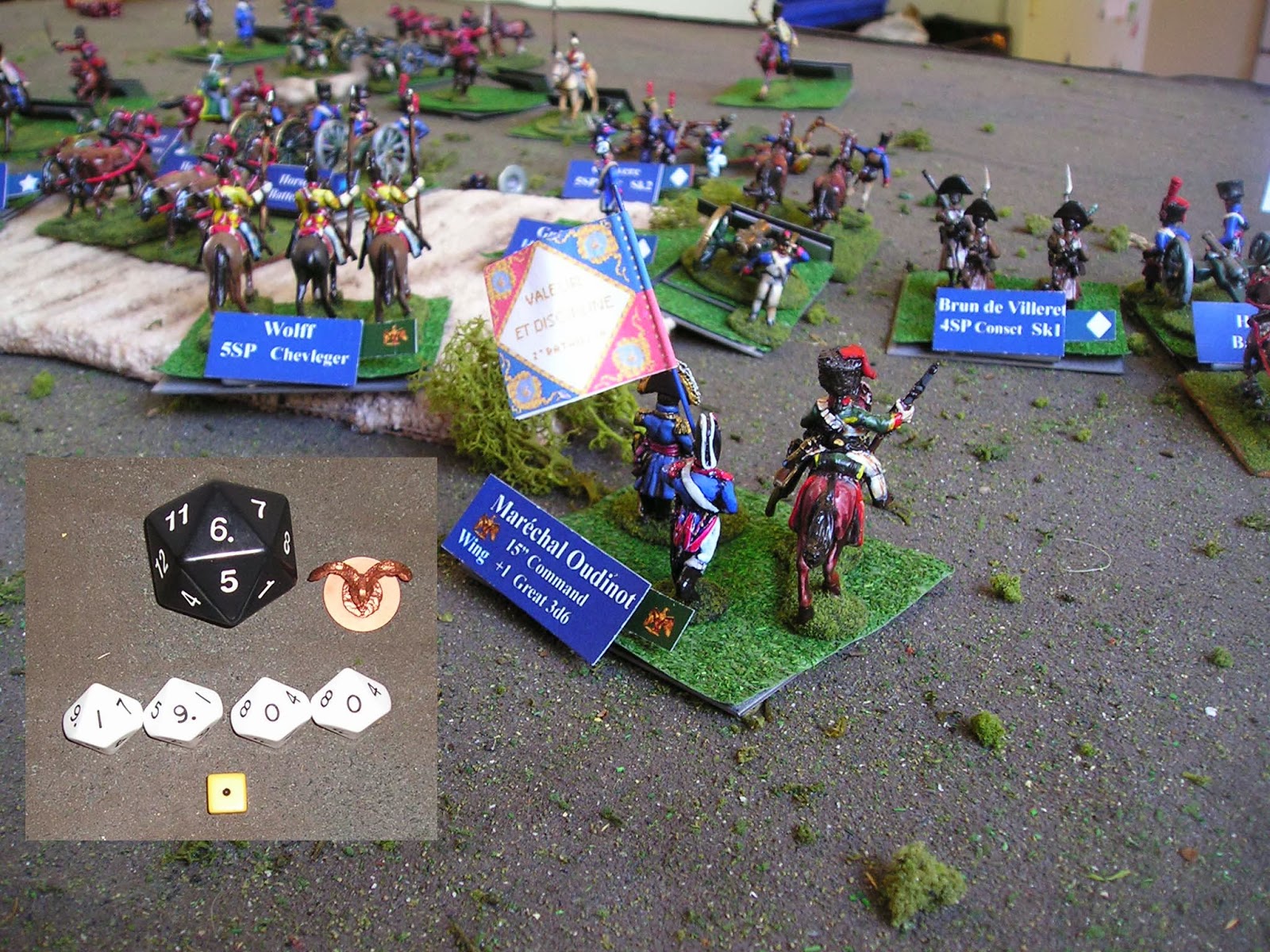
General der Kavallerie Blücher, commander of the Army of Silesia had set himself the task of clearing away Maréchal Oudinot and his XII Corps along with II Cavalry Corps General Sébastiani of the Grande Armée.

These forces had already met in battle near Rothenburg (part 1 :: Part 2 :: Part 3), though XII Corps had time to gather their wits, the Russians had gathered another cavalry Corps ...

This time however the horse had to cover 18 miles to get fully around the flank of the French who only had to march 6 miles.  This meant that the Russians would have to force the French to stand and fight, holding them till past nightfall.

 The ground for this battle was mostly flat farmland, with only two low hills from which the French would be coming out from.  Setting up blind, the French took up the widest frontage possible with massed artillery in the center, while holding the Chasseurs of Excelmans in reserve.  Blucher chose to swing wide right, to avoid the bulk of the French artillery and make an effort to sweep hard into the French left, held by Saxons.

late in the day Blucher caught Oudinot, battle starts on turn 6

Not wasting any time, Oudinot drove forward those divisions which did not have Russians blocking their path out of the battlefield.  The first rounds of artillery were at long range and had no effect.

French breakout in the north and make ready to receive Russian Dragoons in the south
The Russian half of the turn was to make the whole battle line pinwheel in a counter-clockwise direction.

the battle line shifted counter-clockwise all evening
Oudinot wasted no time in moving two divisions to escape the Russian trap
even with the rush off the Russian left flank, there were enough to force a fight or two
With the second pulse the Russians won initiative and used it to good effect in sweeping well past the fire arcs of 25th Division, putting Cossacks within striking range of the French rear.  Other Cossacks facing French Hussars and Chasseurs did not fare so well.

Russians win initiative in pulse 2 and keep moving to the flank
25th Division was clearly the target of Borosdin's Dragoons and the leftmost brigade crumbled under the combined assault. 

Russian Dragoons take no casualties in their first assault
Sebastiani personally assists in close battle with Russian Hussars and Cossacks
French Chasseurs are moved to the center - response as needed?
The turn ends after only two pulses and now the Russians again win initiative.  Blucher uses some of his command dice to move headquarters so as to keep near the fighting and support it if needed.  Likewise Oudinot was to move his headquarters every turn also, though more to escape the jaws of another Russian trap.

Turn 7 and the Russians keep the pressure on
25th Division is cut apart and looses all their artillery to Russian Dragoons
For the French, now almost two Divisions had escaped, along with the Corps artillery, now though the reserve Chasseurs had to turn about and take up new covering positions.  Would they be enough to halt the triumphant Dragoons?

French are escaping ... though there may not be enough cavalry to cover the retreat?
Chasseurs turn about, to cover the now threatened rear
Oudinot's view, now past the center of the field, could he shepherd out more of the battered II Cavalry Corps?
Blucher's blood was up ... capture the hill and get those guns into action!
Wolff's brigade charged the Russian guns, they fled ... though now there was room for the French to escape
two full divisions would have escaped had Pacthod not stalled on tun 7 pulse 1 and rolled a "6" = Hold
Now the battle could have ended, for turn 7 had come to an end, again after only 2 pulses, and the Russians had lost just more than enough brigades (due to one fleeing off table in the first pulse of the battle) to trigger a morale check.  They passed the test and so turn 8 was to come about.

Turn 8 started with the usual command die rolls, this time the French were totally in command of the situation.  They were to have a total of 16 CD's to the Russians 9.  This would mean that the French could afford to do many re-rolls and add plenty of die to combat situations.

the smaller blue (French) and red (Russian) die tell the tale of the CD's for turn 8
French win initiative on pulse 1 turn 8 and conduct more forces out of the area, only Chasseurs remain to cover retreat
Sebastiani again leads directly from this critical rearguard action, while 25th Division desperately moves to get more distance from the Russian Dragoons
Indeed the Chasseur Division is split to ensure that at least half will escape the field ...
d'Hurbal's division was not to survive the Russian artillery, who eliminated that last of the Hussars fleeing
Pulse 2 the Russians won out the initiative, though by then it was too late to do much more than pressure the last of the Chasseurs.  With Sebastiani leading them (and his bonus dice) the Dragoons were forced back, with more losses, while the Chasseurs took none!  (yes I was surprised by the 1's and 2's that the Russians threw in that battle).  Now the French could escape for certain.

Russians could not catch the elusive Frenchmen
Blucher takes the hill and command of the guns from 25th Division
The Karkov Dragoons were thrown back by French Chasseurs led by Sebastiani
25th Division was eliminated by the New Russia Dragoon brigade only the commander and his staff managed to evade destruction on this field.
The result was another fighting retreat for the French, losing more cavalry and the 25th Division.  Blucher and the Russians hold the field and recover more of their losses, though many Cossacks and a Hussar Brigade are not coming back.  At least the remaining horses will make good draft teams for the captured batteries of 25th Division.

French forces that escaped in some confusion
Russians that will be fully recovered by the morning
The Campaign of Nations continues ...

Monday, October 21, 2013

Two centuries on ... Leipzig climax

Destruction of the causeway over the Elster, climax of Leipzig
Over the four-day period the Allies lost probably 54,000 killed and wounded, although accurate figures are extremely hard to calculate.  As for the French, their battle casualties were probably in excess of 38,000, but a further 30,000 fell into Allied hands during the 19th.  Additionally, 5,000German troops defected to the enemy during the battle.  The French losses included six general officers killed, a further twelve wounded, and no less than 36 fell into Allied hands as prisoners of war, a fate also shared by the King of Saxony.  In terms of materiel, Napoleon abandoned at least 325 cannon, most of his trains and transport columns and large quantities of military stores.


the Napoleonic eagles had been forced to bow out of central and eastern Europe
This long battle was the severest of the Napoleonic Wars save only for Borodino; over 200,000 rounds of artillery ammunition were discharged, and by the 19th the French stocks were down to a mere 20,000.  The ultimate result was to destroy what was left of the French Empire east of the Rhine.  Bavaria had already deserted Napoleon's cause; Saxony (apart from Dresden where St. Cyr and Lobau held out until November 11) was occupied by Allied forces and forced into a form of agreement with the Allies.  Within a few days the ruler of Wurttemberg was forced to follow Bavaria's lead, and  this event inevitably led to the remaining principalities of the Confederation following suit.  Militarily, Leipzig dealt a heavy blow to Napoleon's martial reputation, and eventually destroyed over two thirds of France's hard-found forces outside Spain.  Politically, it marked the emergence of Prussia as a leading power in Germany once more, and prepared the way for the birth of modern Europe.

~ D. Chandler, The Campaigns of Napoleon, p. 936

Thursday, October 17, 2013

ECW preparations continue

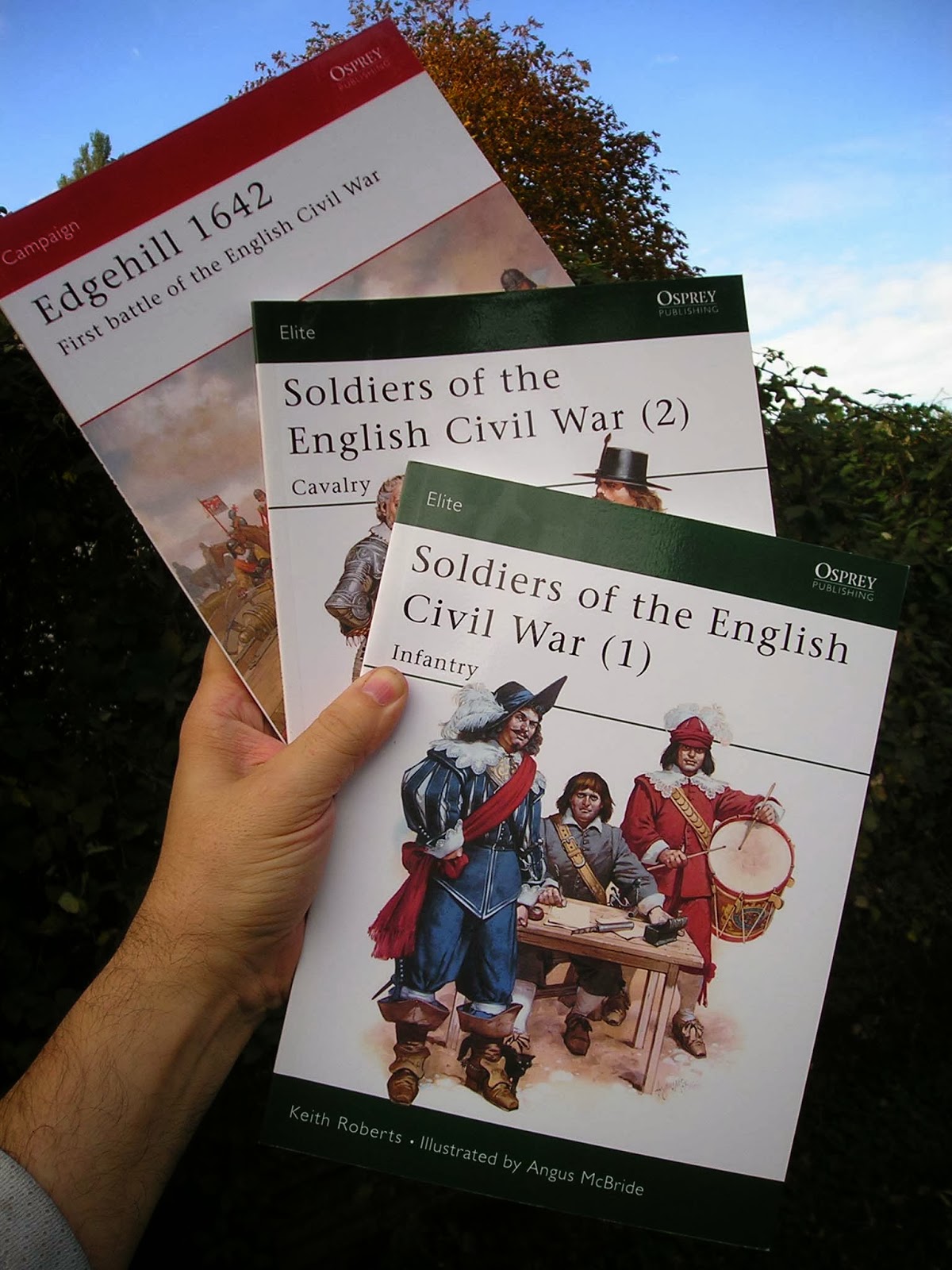
ECW Planning books
At the risk of sounding like something from a shopping guide, I shall share some of the recent additions to my game research library.

The English Civil War takes on center stage, something that Bluebear Jeff will no-doubt like to hear.

I picked up the Edgehill 1642 Campaign book and Cavalry and Infantry of the Elite line by Osprey for Soldiers of the English Civil War.  This should feed in all the detail information I need to put color into the troops now massing.

Speaking of the massing, I also picked up some 10 meters of .64mm wire for use as pikes and spears!

A replacement tool was needed for my flush cutter, as the old one was no longer cutting 'flush'.  I decided to spend a bit more than usual on what I hoped would be a higher quality product, I am most pleased with the results from this tool!  The cutting head is hard and sharp and the 'flush' element is excellent, now to see how long it will keep working with the sometimes heavy load I put through such tools.

Finally I have added the Prussian personalities to my list and will have the key elements and commanders all ready for Waterloo.

A great 90 minutes in Imperial Hobbies.

Wednesday, October 16, 2013

LEIPZIG Two Centuries on ...

Battle of Leipzig
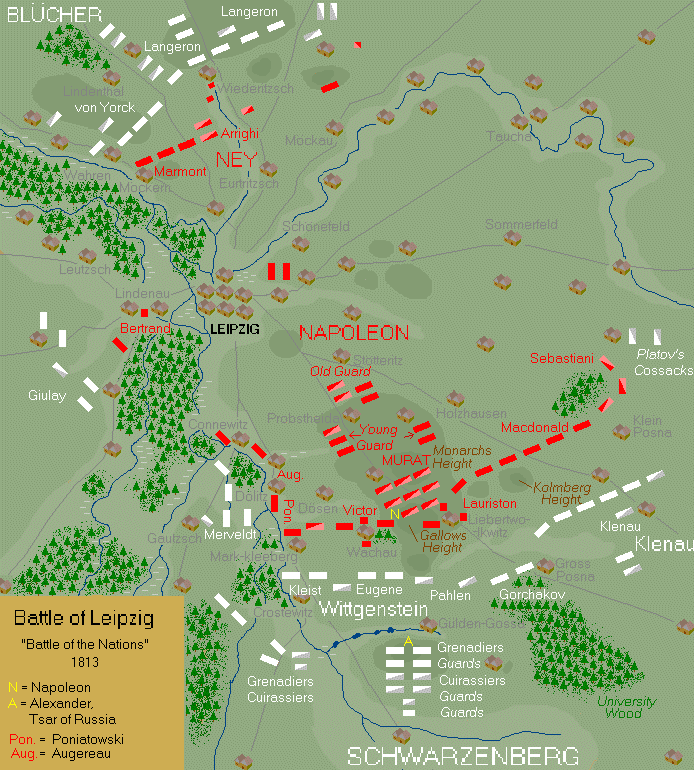
The battlefield of Leipzig covers a wide sweep of ground, divided by the Rivers Elster, Pleisse, Luppe and Parthe.  The city stands at the confluence of the first two named, and in 1813 the terrain separating them was extremely marshy and wooded.  The old city and its suburbs lay to the east and north of this difficult area, and the single road running westward from the Rannstadt Gate to the village of Lindenau was carried along an extensive embankment cut by several wooden and stone bridges.  Near Lindenau, another stream - the River Luppe - leaves it parent the Elster and runs away to the northwest roughly parallel to the main river enclosing between them another swampy region.  Immediately to the north of teh suburb of Pffandorf, the Parthe tributary leaves the Elster in a northeasterly direction, before describing a broad southerly sweep towards its source near the Kolm Berg.

These four rivers, radiating out from Leipzig, divide the surrounding circle of country into four main sectors.  Approximately to the south of the city lie the marshy areas already referred to.  To the west, between the Elster and the Luppe, lie two roads, running from Lindenau to Merseburg and Weissenfels respectively.  Here the groun is at first very flat and open, but five miles down the Weissenfels road near Markranstadt the terrain on each side of the highway becomes increasingly hilly.  The northern sector lies between the Elster and the Parthe and the Upper Pleisse.  It is marked by a series of low ridges running outward from Leipzig toward two pieces of relatively higher ground - the Galgenberg (lying between the villages of Wachau and Leibertwolkwitz) and the Kolm Berg, some two miles to the east.  Although the undulating nature of the terrain and the large number of villages and hamlets made it a naturally strong defensive position, much of the countryside was very open and well suited to large-scale cavalry action.  Several important roads cross the area, running outward toward Wurzen, Dresden, Grimma, and Borna.  Linking these were a large number of earthen lateral farm tracks of dubious military value.

As for Leipzig itself, the old town was surrounded by an ill-repaired wall, but the main gates were in fair state of repair and the French had taken steps to fortify the outlying suburbs.  A considerable number of defense works had also been constructed around Lindenau, guarding the important causeway traversing the marshes.

~ D. Chandler, The Campaigns of Napoleon, p.923

See Project Leipzig for excellent game-plans detail for this and many other Napoleonic games.

Thursday, October 10, 2013

100 Days Campaign

Draft game map from Cyberboard
Just open musing about running a 100 Days Campaign, the 1815 "Waterloo" slug fest with three first class armies in a narrow region of Belgium.

Not a full call-out for players, just an expression of interest.

I have run this Campaign using the Napoleon board game and some of my 15mm minis in the past.  This time round I plan to use my 25mm minis and a much more detailed map, along with a more 'kreigspeil' story-telling approach.

Sample of 15mm game from Waterloo Campaign in 2002

Sample of 15mm game from Waterloo Campaign in 2004

Sample of 15mm game from Waterloo Campaign in 2004

I believe this will permit many more players to take part and expand the fun for everyone.

Post a comment or let me know if you are keen to command, take on a proxy battle tabletop game or a few and or BOTH!

Tuesday, October 08, 2013

Shifting fortunes of war, Bavaria leaves the French alliance 8 October 1813

News that the Bavarians had changed sides on 8 October and were indeed about to join the Allied side with 50,000 men changed the political and military situation.  This army was astride Napoleon's lines of communication and could cut off his retreat.

p. 63 Campaign Series #25, LEIPZIG 1813, Peter Hofschroer