Showing posts with label LEIPZIG 2013. Show all posts

Sunday, February 08, 2015

Campaign of Nations - BATTLE OF LUBBEN

With a great clash of arms the Campaign of Nations has come to a crescendo moment.

Imperial Guard
Napoleon Bonaparte has appeared with the Imperial Guard in full force, combined with three other Corps d'Armee in a massive battle for control of the town of Lubben.  General Blücher, had only the day before gone north across the Spree river to drive back the French I Corps.  Now on the 12th of September, 1813 (fictional)  Blücher was going to have to race back with the remains of his cavalry and shore up the Lubben defenses in order to hold on long enough for the Russian reserves to arrive.

This could be the battle to end the campaign, were Blücher able to hold on and the reserves arrived quickly enough.

For the French, this was to be a hammer-blow against the Allied coalition.  Blücher was in Bonaparte's sights, there was a local superiority of nearly three to one and a flank force ought to be strong enough to delay any rescue efforts from the Allied formations in the south near Luckau.

For the 12th though, the Guard would not be risked, as the XIV Corps was still a days march away from the field, so the battle would open with III Corps providing a screen for the advancing Guard and supporting Corps, while the V bis Cavalry Corps would prevent any immediate re-enforcement, by dominating the fields south of Lubben.

For this battle we are using a modified version of Fast Play Grand Armee, fusing it with SCRUD and GURPS Mass Combat system.  Each 'stand' on the field is representing a Division scale of troops, anywhere from 8,000-15,000 men.  The separate artillery stands are for Corps support artillery and must have at least 4 batteries of guns, so each 'gunner' represents some 16-32 guns of the appropriate class, such as horse or foot guns.

Day opens early, with the Prussians in the south, from the west (left in the image) are III Corps and V bis Cavalry, Blucher has not yet returned and Langeron is in command of the forces in Lubben (top right)

von Roeder's light cavalry in the south with supporting guns

Attacking into the south were V bis Cavalry, mostly French Dragoons, classed as 'heavy'


in the south the battle became one of maneuver

von Roeder was taking no risks with the French Dragoons in force, he moved to Lubben

III Corps maintained a slow advance, so as to get into artillery range for the 'real battle' on the 13th
 The first few moves were limited as the armies were out of artillery range, then once it became clear to von Roeder that the French Dragoons were not so well trained nor lead (they were a 'bis' unit meant to re-enforce the real V Cavalry Corps and had only come from depot trainings), the real horse battle was on as the Russian Heavy Reserve cavalry under Gallitizin was dispatched to ensure the demise of the 'green' Dragoons.

Just before noon, the Russian heavies were moving to flank III Corps

Blucher had arrived in Lubben and had brought all the Cossacks with him

Russian Heavies pushed back French recruit Dragoons, then turned to threaten the flank of III Corps
Once Blucher arrived, the 'initiative' rolls tended to favor the Prussian experienced team of Blucher and Gneisnau, whereas up till then the French newly minted Maréchal Poniatowski had been winning the initiative contests against Major General Langeron.

the field had collapsed down to Lubbn by 14h00

The V bis Cavalry French Dragoons were not going to be able to make any further effect

Russian Cuirassier had crushed half of the Dragoons force

then Blucher decided on a bold stroke => ATTACK!

Sensing that III Corps was not going to take any further action that day, and knowing that more French would arrive before any Allied forces, so this would be his only chance to break up the French momentum

Cossacks CHARGE!
 The assault very nearly succeeded in forcing III Corps off the field ...

by 19h00 the field was quiet ... with the Russians back in Lubben and the battered French still tentatively holding a ragged line to the west.

13 September 1813 (fictional) dawned to show clearing skies and the points of the 40,000 bayonets of the Imperial Guard, standing behind a line of a further 40,000 troops of XIV Corps, now lining up with the remains of III Corps.  Further to the flank was the remains of two more Corps, that had been retreating away from the Army of Silesia for the past two weeks.  On the far flank was the I Cavalry Corps.

An epic struggle was now set.

Bonaparte vs. Blucher, with the winner likely taking the spoils of the campaign, for there were literally no more reserves for either side to fall back on.

on the next morning, the field was fully covered to the west

XIV Corps lined up with Guard and III Corps artillery

Immediately to the rear of III Corps was the Imperial Guard

spreading further south were another 40,000 French infantry and more artillery

from the vantage point of the V bis Cavalry, this day would see many more French actions

Bonaparte himself, present to oversee the destruction of Blucher and the latest coalition in Europe

This time the French were to take no chances and advanced at a steady pace until artillery could batter down some of the defenses in Lubben.

07h00 the French merely move up across a 6 mile front

Blucher is informed that the reserves could not arrive until nearly nightfall ...

now confident that the field was his for one day, Bonaparte moves his army in for the kill

great masses of troops converged on Lubben

Most of the day was spent in maneuver as artillery batteries fired, aiming for supremacy so that the assaults could progress with limited casualties, though XIV Corps was now the primary target of Langeron's Russian Position Batteries and many brigades - indeed three divisions were broken by this barrage.

at 14h00 the assaults were ready to take place ...

huge formations advanced into Lubben ... each 'stand' is a Division of some 10,000 men ...

this time nothing was left to chance as massive batteries of the Guard 20# guns were brought up to close range

one small foray of cavalry was sent out, only to break up the relentless French advance

squeezing ever tighter on the Lubben defenses, Blucher began to examine the escape orders ...

by 17h30 the massed horses of I Cavalry Corps were ready to repulse any Russian re-enforcement

the Cossacks had already been ordered north across the Spree as now the ragged lines of defenders in Lubben were breaking down

disappointed with the retreat of XIV Corps, Bonaparte now orders Guard Divisions into the line, the time has come to storm Lubben.

fragile shadows of Divisions remain in the shattered barns and mills of Lubben

while Imperial Guard divisions muster for the charge

the huge hole of where XIV Corps had been is now getting a short rest, while VII Corps is moved to assault
Blucher manages to get the Cossacks and Cuirassier and some Dragoons across the Spree river before the breach in the lines became indefensible.

the field at sunset on the second day, Lubben was taken by French storm

in the far south Russian Grenadiers and Guards pushed to reach Lubben to no avail

Maréchal Mouton used I Cav Corps to hammer at the Russian reserves

The escape of Blucher with the remains of his cavalry was a small price to pay for this victory

Imperial Guard Divisions stormed the battlements, facing a hail of shot and shell until they were over the barricades

Blucher and his Cossack escort were able to retreat over the Spree, though many of the Russian foot troops were unable to retreat in the chaos as night fell.

The commander of 9 Corps GM Aleusiev was left with 17th Division to cover the retreat, which they did until nearly midnight as the surrender was accepted

17th Division formed the final block in stopping any effective pursuit by French troops.

Most of the French Cavalry was engaged in the south, pushing back Russian Guard and Grenadiers until well past sunset.
The final result was a French Victory.

Though not without great casualties.

I suspect this may be an end to this campaign as the Allies will need a week or two of retreat in order to get any sort of line re-formed and this would likely not see a combined force either, as the Prussians were mostly decimated before the battle, now utterly without firepower at this stage of the campaign.

Saturday, November 29, 2014

Garden Wars LEIPZIG

Bonaparte, a man who defined his era.
With the last sunny day of summer I managed to lay out the Leipzig battlefield in the backyard Garden War zone and game-out the grand battle of Leipzig.

I used a hybrid of FPGA and SCRUD to make the action move forward, as I needed to simulate multiple days of battle and found I needed to use nearly all of my 3"x 3" sheet steel squares in order to run the game with the miniature stands representing an entire Corps in strength.  I treated the stand as the Corps in tight battle formations and permitted a double width 'control zone' around the stand for infantry and triple width for cavalry corps formations.

The map needed to be simplified in order to fit this change in scale considerations and this was pretty simply accomplished, as there were only four main 'towns' around Leipzig that had any impact on the historical operations.

The field of battle, still in early morning shade, rivers and swampy area marked with blue dye on wood chips.
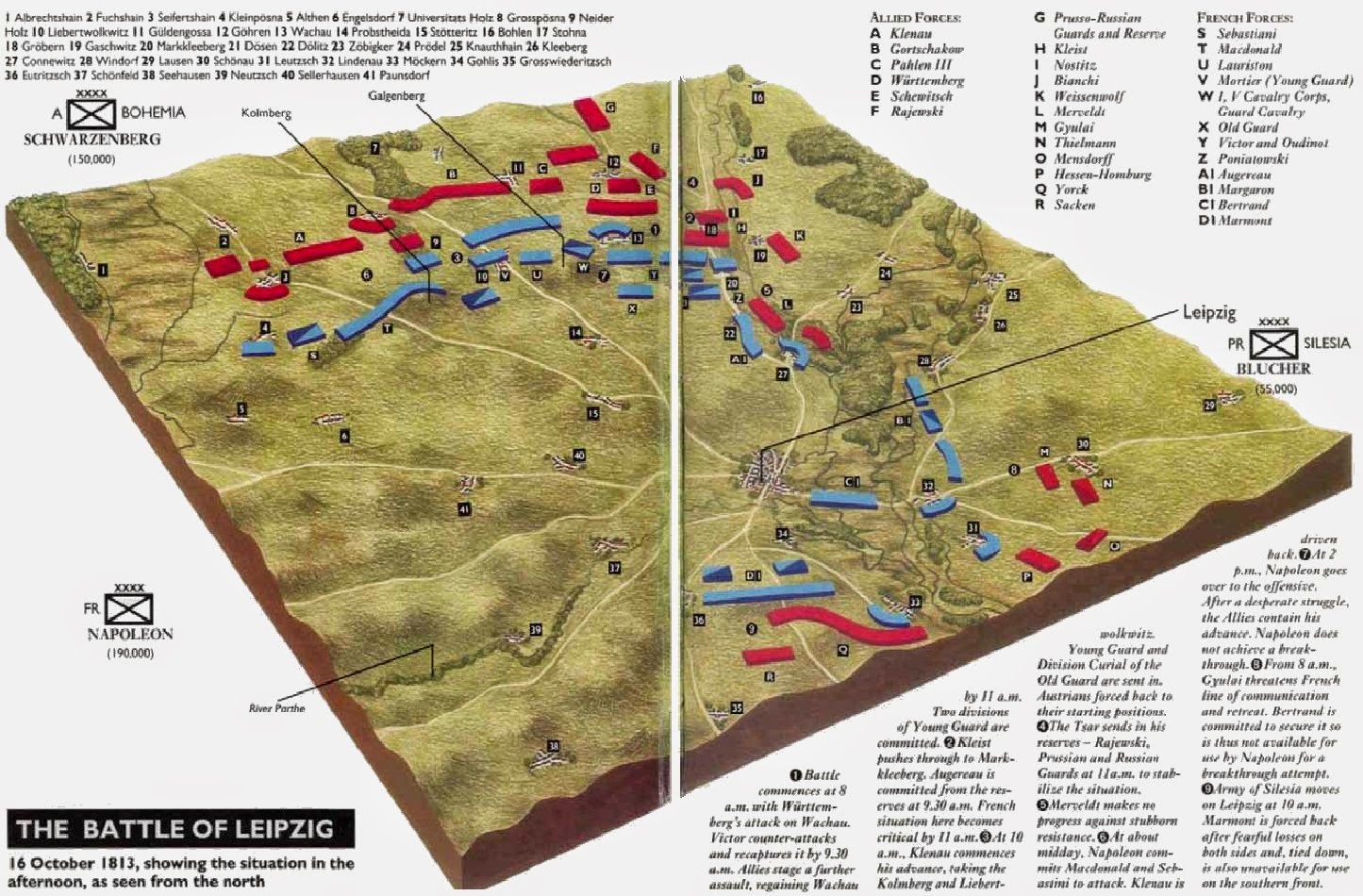
Map view from the Osprey Campaign series.

The troops were then assigned into the sectors of the map that they were in historically on the 16th of October 1813.

The Allied command, looking west towards Leipzig.  All of the better troops and largest Russian formations came from this east corridor between forested sections.

South of Leipzig is where the Austrian formations were massed, here FML Prohaska can be seen backstopping two other Austrian Corps looking north toward Leipzig.

Far in the north east General Barclay held the flank with just one Austrian Corps to start with, he knew that two more Russian Corps were coming up in a day or two and that to the far north the Swedes and Prussians were coming, with Blucher planning to arrive from the west.  All Barclay needed to do was hold his ground for the time being.
Commanding from Leipzig itself, Bonaparte surveys his deployment.

In the southeast, facing a mix of Russian and Austrian cavalry were I Cav Corps and the Guard Light Cavalry (not seen in picture) under the experienced command of Murat.

Facing directly east in the open ground was V Corps under Lauriston.
 Each 3 inch square stand would have infantry, cavalry and artillery in proportion to the number and quality of divisions in the Corps sized formations.  Thus if a stand did not have a cannon on it, that did not mean there were no guns present, only that there were too few to make the weight of cannon fire felt at the scale of the game.

In Liebertwolkowitz were stationed the middle and young guard with their artillery.

The balance of the guard and the massed batteries of "the Emperors beautiful daughters" were west of the front lines and stationed so as to fully support the east most line and form a superior reserve.  They were facing south in support of the first planned actions of the Emperor ... the elimination of the Austrians in the south sector.
After some time studying the ground and dispositions of the forces, I could see why Bonaparte chose to strike in the south early and hard.  If the Austrians could be 'rolled up' into the south flank of the allied lines then the whole position of the attacking forces could be flanked and thus totally blunted, or perhaps cut off and destroyed in detail before any supporting army from the north or west could make effective presence on the field.

Guard in Liebertwolkwitz poured out fire into the advancing Russians

Lauriston and V Corps took disruptions, and held their ground

Murat and the Cavalry made early charges into Austrian Cuirassier, breaking contact between the Allied center and left (in the south)

Austrian Cuirassier forced back

In the south, combined arms of the French strike at Austrian Corps, inflicting many casualties, while Guard units move into Markkleeberg to support the assault in the open.
22h00 the Allied line in the south was quite distorted and the east column had not gained any ground

Murat was driving out Austrian Corps formations on the right and left in the south

Allied command had not moved, nor had the great columns advance much that day.

A fair start for the day for the French, yet to have cleared the south would be been better ...
Overnight maneuvers only - no combat permitted (save for units still in contact at end of day) also arriving units for dawn next day are announced - I am literally making up the rules for this one on the fly.

Allied command determining to hold ground on the left (south) by pulling back and delaying any French assaults

On the other end of the causeway - opening the escape route, Bertrand is dealing with two Austrian foot corps.  He has equal numbers of foot and advantage in cavalry ... the prospects for the Austrians do not look good.

Pulling back, the Austrians attempt to re-assemble a line

Nearly all the Austrian formations in the south faced attacks on the 16th and the prospects for the 17th looked like more battles directly with French

A deadly game of chicken was shaping up in the north, where Barclay de Tolly faced off against French cavalry with an infantry corps ...
Even before dawn on the 17th the French artillery were active probing the Austrians in the south.

the Allied lines had stabilized in the south, now they would be tested by the French yet again

in the east, the great Allied column surged forward, artillery of both sides exchanging fire

A Russian corps, caught in a box by French foot and cavalry corps ... no way out trapped against a woods
The morning went badly for the Allies as Austrian and Russian corps were cut apart by fast moving French cavalry corps, it looked like Bonaparte's plan to strike hard in the south was going to pay off!

by noon on the 17th the field was looking clear in the south, while leading Prussian formation were showing up in the West

Bertrand on the far side of the causeway had only one more Division of Austrians to overcome, whom he had outnumbered and outgunned ...

Marmont, in the west was now facing the prospect of being surrounded, wisely he began a withdrawal to the riverline

only remnants of the Austrian forces remained in the south

Allied command was getting impatient with the continued hold-up of the great column to the east

Russian Grenadiers and Guard were hurled towards V Corps, while massed Russian batteries pounded Liebertwokwitz in vain attempt to dislodge the French Guard from the town.

again Murat arrives with cavalry to outflank Allied lines, this time Russian Dragoons are caught in the trap

fighting valiantly the Russian Dragoons and Guards struggle to hold ground

the 3-in square bases with FPGA labels

unable to return fire now, Marmont will accelerate his march to the river

The light cavalry division with Marmont will permit the withdrawal as the flanking Russians have no cavalry

like a deep breath being released a moment of delay in the post noon turn, now many formations have been driven out of range in the south and a need for re-deployment comes for the French

all the while V Corps under Lauriston (though disrupted - the smoke) were holding their ground and keeping the massive column to the east from advancing.

Russians push forward, to close range, as they did not want to become trapped by the superior French cavalry

Now a second line was forming up to face the east column

while in the south a follow-up was being conducted to keep the Austrians away for good.
in the failing light, now the French had to hold ground against the east column, while in the south Austrians were sent scattering in all directions.

A wider view to the west, showing the cleared causeway exit and the rising pressure from Prussians west of the river and north of the causeway

Allied forces rush from the east again in effort to break the French line

whole corps are used to shield Yermelov's guard from Lauriston's guns

the south was cleared of Austrians, while the east column was again stopped

in the north, Barclay de Tolly was able to move cautiously forward as the French cavalry was being pulled back to cover the French left

unable to escape the pursuit Marmont did his best to keep his men together so as to cross the river if at all possible in the face of Russian and Prussian attacks
Mortier and half of the Guard kept Russians from advancing till dark

The surge of Russians could not be completely stopped, as Guards and Grenadiers reached V corps

Other French formations were unable to assist as Murat had them formed up to cover Prussians

This was a battle Lauriston would face alone

flanked and needing to simply withdraw the option was at least available so Lauriston would not be destroyed this day
The overnight moves again were plotted and this time Blucher arrived in the west and Crown Prince Charles John (Bernadotte) arrived in the north, marching up behind Ney, who was falling back with the remains of the Army of Berlin.

field overview at dawn, French have formed a tight line to the east, while in the north a vast host bears down on Ney

Having taken 11 Corps worth of casualties in two days of fighting the Allied command was set to gain some victories this day!

Seeing the critical nature of the situation, Bonaparte himself commands the Imperial Guard in support of the battered Lauriston to halt the Russian columns advance

in flank support, to the south of the Guard is Murat with the Guard cavalry and I Cav Corps

The moment of truth for the campaign had arrived, was Bonaparte still up to the task?

The east flank, as seen from the far south positions, still moving to re-deploy from battling Austrians the day before.

Other light cavalry was also being moved to the north as it was clear that Ney was outnumbered and would need the help in reaching the French lines.

Barclay de Tolly also had re-enforcement and was preparing to pressure the French from the north east flank

While the Swedish Crown Prince arrived with his formidable Prusso-Swedish force, in pursuit of Ney

Ney had turned his forces to face the pursuit.  One of the Emperors fire eaters, the Prince of the Moscwa was not to be discounted.

Polish forces were part of Ney's contingent.

far to the west, Blucher drove forward with his Prussians.  The box for the French in the north of Leipzig was closed.

Prussians and Russians prepare to cross the river and join the pursuit south into Leipzig

as the armies exchanged fire in the east, the first Imperial Guard division of Old Guard is shattered

cheering erupts from the Reserve and Guards corps as they see a corps of Imperial Guard recoil from their cannon fire!

only a recoil for Friant, for the Guard can take quite a pounding before any failure of morale
by noon, the Allied impetus had faltered and again the French were on the move

Barclay, in the north had to delay as his supporting force came up

at the river line, Blucher was in mid crossing

one bright spot for the Allies was an opportunity to overwhelm a French Corps

While over at the main line, the Allied assault had reached V Corps and Bonaparte was there to bolster morale

the exchange was furious, while V Corps sustained disruption and the Russians did not, this was not good enough of a result for all the price it had taken to reach this point.

Grand Duke Constantine and the Guard were not satisfied

only a single Guard division had been broken for all that effort
late in the day, the French again form a defensive line to the east of Leipzig and still in the north Ney is backing away from masses of Prussian, Russian and Swedish forces.

One more effort from the Guard.  Halt the Russians and the day may yet be won!

Scrambling to cover the flank one lone Austrian corps combines with Russian Hussars and Cossacks to drive off French

The east line chooses not to advance, rather they take on an isolated French/Italian Corps

... and eliminate it!
as nightfall approaches the French are recoiling everywhere, while the Allies are struggling to find the forces to keep up the pressure from the east, in the north there are ample forces to contain and possibly take out Ney's entire command!

looking north, the French are seen to have re-set a defensive line in the east and are scattered to the north

Ney's command comes under fire on three sides.

No more room to maneuver, Ney must commence a full withdrawal

While Crown Prince John and FML Stedinck are set to pursue!
the overnight move saw more French retreat with progressive Allied follow up

something to celebrate at last after three days of battle, Bonaparte was caught.  The problem was that the price to catch the French had been so great as to make destroying them a near-impossible task.

Undaunted, the Allied cavalry formed up

holding the south alone was one French corps

While the Emperor and the Guard formed a gun line to stop any hope of victory from the east column
By dawn of the 19th it was clear to Bonaparte that Ney could not stop the Allied forces in the north, so an orderly retreat was commenced, the causeway was clear beyond Lindenau so the army was assured to make good a general retreat once the crossing had been conducted.

Only progressive covering forces would be needed...

by noon, the French had effected further withdrawal

Lauriston had been set on the causeway

Augerau was crossing the Elster

Marmont was tasked with holding back the Prussian tide along the river from the north

Ney had become surrounded, with his back to a woods and the river rushing before him in the distance ... his tale vanishes at this point as his command is over-run

More Russians, Prussians and Swedes surge down from the north

Scrambling French light cavalry manage to contain the northern breakout one more time

Allied luck holds as they win the initiative option yet again

in a last act of defiance Ney goes down with a French Corps
late in the day, the Allies could not manage to catch up with the fleeing Frenchmen, though they did still inflict some more casualties - degrading the effectiveness of those units still in the field

Pressing forward from Liebertwolkwitz, at last the Russian Guard were going to move on

backing off, now Bonaparte was in Leipzig again, this time with no room to maneuver as Allied forces were closing in on two sides

Prussians can be seen in the distance from Imperial QG

Poniatowski crosses the Elster, this time alive and well

Augerau on the causeway

Lauriston clearing the causeway and leading the retreat column to the Rhine

looking north from the bridge, all Allied forces beyond Marmont

Murat gets in one more kill with 3 Cav Corp and the Guard Cavalry

luck continues to favor the Allies in moving first ...
the Allies maintained the initiative into the night

The Allied Monarchs set up in Liebertwolkwitz, now clear of French Guardsmen

a larger line was now formed to the north of Leipzig, so Marmont was no longer alone in holding off Blucher

while the Guard formed east of the city, the last rearguard

Murat maintained a mobile force facing the north, certainly keeping away any Allied cavalry till well past dark

Barclay de Tolly was happy to have eliminated the corps that had harassed his positions for two days, now at last with Bennigsen, they would move forward to the south.

turned to face west now, Crown Prince Charles John had the last French light cavalry corps pinned against the river

the two grand head-quarters looking across the field at each other

the view looking west on the bridge and causeway, now filling with French soldiers, horse and guns

an overhead view of the north facing defense line
The 20th of October 1813 was the last day of action in this recreation, for the French had certainly got away with the majority of the troops and the best the Allies could hope for was to sting the Guard one more time ...

the Allied Monarchs push forward in one last attempt to sting the French

More French Grande Armee forces safely cross the river, this time including the Emperor

seen from above, the Leipzig defense and causeway

one move later, the Allied forces had now lost greater than 1/2 of the starting total Corps - the great battle was over, the Allies were too exhausted to move any further

Arrighi would manage to slip away from the Swedes, Prussians and Russians - perhaps in a rain shower?

the great bridge and causeway would remain open for the rest of the day, permitting the Guard to withdraw ...

spread out in a long column, more like a medieval army, the French Grand Armee would march to the Rhine, with only a pause at Hanau on October 31 to swat the foolish Bavarians for daring to change sides and stand in the way

though many formations were battered, the French did better than the Allies at sheltering damaged formations

seen from Lindenau looking to the east northeast towards Leipzig, the causeway is jammed with men & horses & guns

though forced to retreat, this time Bonaparte escapes with most of the army in-tact, making 1814 and the Natural Frontiers a more difficult campaign for the Allies

The Guard proved their mettle again, though taking damage the formations remain.
A great day out in the late summer sun, now reported here on the cusp of mid-winter.

I have a better understanding of the multi-day grand Battle of Nations and from this perspective I shall state that I do not believe that Bonaparte could have changed the outcome of the battle in mid October.  The events of the Campaign had conspired to create a situation that could not be so easily overcome.

In this re-fight, Ney was victim to his own hubris, for had he pulled back sooner then the French forces could have had a chance at crossing the bridge and causeway.  As it was, Ney was a sacrifice, he could have been killed or captured, or he may have slipped the Prussians and dove into the Elster, possibly ending as Poniatowski did historically.

What great battles have you game'd out in the past few years?

What insights have playing those games brought you?