Monday, September 17, 2012

Garden Wars AAR I


September 3, 2012 saw a pair of Garden Wars games.  The first was a meeting engagement with supporting forces, between my newly finished Italian forces and my Russian veterans.  As before we used SHAKO (version I) rules at double scale.

Situation:  Russia before Borodino.  Russian Divisions with Cossacks must hold the extreme right flank of the army positions against the Army of Italy, with a supporting division of allied and French troops.

Russian command in the center of the crossroads
Russian divisions were posted in the town, to block the one bridge, known crossing, and open ground to the left of the town - linking communications to the next sector of the Army.  On the right flank - extreme distance - were a force of Cossacks.  All troops in contact with the river may search for unmarked ford spaces, on a roll of 1-2-3 river is non-fordable, 4-5 fordable with a halt and disorder, 6 fordable with a halt.
Deployment of the troops (map from Battle Chronicler)

After seeing the Russian deployment, the French (ok mostly Italian) forces are arrayed in their marching order with commands given to them for the assault.  The objective is to gain the far back of the river and dominate the bridge and crossroad, thus breaking the right flank of the Russian Army at this river.

Right from the start there were 'detections' (we use cardboard 'blanks' to show where divisions are until they are within 3 yards - 108" of enemy formations). The Russians out in the open and French Light and Heavy Cavalry formations became visible.
The wide view of the field, Russians are on the near side of river, French on the far side
French to the left, Russians to the Right and in the town.

By turn two most formations were visible and the artillery had begun to fire.  Russians scoring hits on the Chasseurs and the French Heavy Cavalry artillery getting setup.
Cossacks explore the river line

The Cossacks determined that the river area in their front was not cross-able (rolled a '2').
The whole French and Italian and allied column
Army of Italy, Eugene at the head of the columns

Meanwhile the French and allied division was closing in on the bridge, followed by the Italian Legion.  We permit commanders to 'move' HQ during the game by their not being able to use the ADC's and issue order changes for two moves.  Here Eugene is marching just behind the leading French and allied division leading the Italian forces into battle (for the first time - no this is not the Eugene model that I sculpted ... that one is not finished yet).

Army of Italy in columns of march
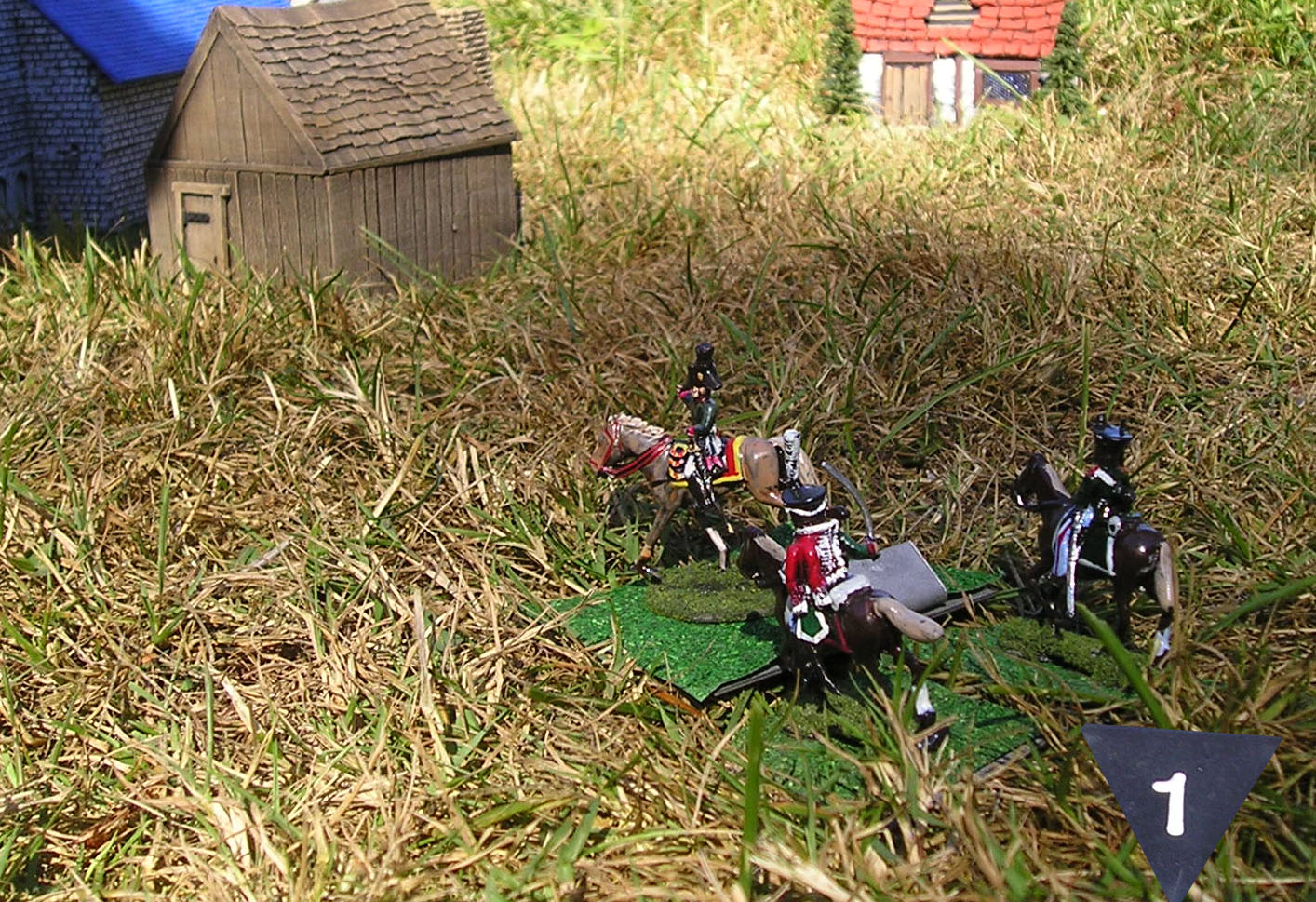
Over on the French right, the Light Cavalry, consisting of Lancers, Chasseurs and a 'provisional' horse battery were racing towards the river line to seek a crossing point.  This 'provisional' battery was the one that the French had captured from the Russians in a Garden Wars game last year ... my eldest son wanted very much to capture it back!

French Light Cavalry and a 'captured' Russian Horse battery
This Light Cavalry force wasted no time in finding a ford and crossing it!

Finding a ford immediately and crossing it the French Light Cavalry were lighting fast!
The Russian division facing them also wasted no shots as they managed to deliver shot into the Chasseurs on both turns scoring kills at long range.

Russian Lines and Jagers prepare to face the Light Cavalry
While in the center of town the artillery was prepared and the troops distributed to what the Division commander thought were the best choices, as French and allied infantry columns closed in.

Center of town with Russian batteries and infantry
For the early part of the battle, the critical factor would be control over the bridge, and both forces were bent on keeping it for themselves.

The Bridge from the Russian side
The Bridge from the French & allied side
The vital bridge turned out to have a weakness, unseen at the start of the battle, for a force of French voltigeurs discovered a fording point that was masked by the watermill from the Russian guns, now the fight for the town would have a whole new dimension!
The army of Italy could now choose where to make the crossing ...
Meanwhile on the French left the heavy cavalry horse battery had begun to punish the Cossacks on the far side of the river.

French Dragoons and Hussars, with a horse battery to the left.  In the distance are the Cossacks
French Hussars of the Heavy Cavalry force, watching Cossacks in the distance take artillery fire
The Light Cavalry did not waste a single moment and struck directly at the Russians facing them.
French Light Cavalry Brigade strike first

Though a square was formed, it was facing nearly twice as many horsemen, the end square failed - the horsemen pressed on and took out the attached battery, then struck into the next line which also formed square!

This time the square held, bouncing out the Lancers that drove over the other square and took out the battery.

Battle Chronicler report of the situation after the 8th Lancers had been repulsed
Over in the center, the Russian batteries were dealing out fire and death on the Italians.

Russian Division holding the town sector

Now at the end of turn 4, start of turn 5 the French Light Cavalry was in disarray, the Lancers did not rally right away and the Chasseurs had been in the first charge and was now still 'blown'.

Light Cavalry in disarray
Over on the Russian right flank, the Cossacks were taking ever more casualties ...

Cossacks are taking more casualties
These casualties were coming from the mouths of the horse battery of the French Heavy Cavalry force facing them on the opposite bank of the river ...

Italian Horse Battery in action, Cossacks can be seen distant at the top left
Situation in the center ... before the Chasseurs charged

Now the French Light Cavalry is hurled one more time into action, the Chasseurs had a fantastic target!  There was one Russian battery that had no 'covering' force any more, they were facing away to the flank (firing at the Italians moving in).  Such an opportunity was not to be missed!

Chasseurs a Cheval were triumphant over the Russian battery
With this destruction of the battery, only one artillery force remained to the Russians and it was now under threat from the French columns that had crossed the river on the other side of the watermill!

The town was now invested with French, seen to the top left are the columns (between the buildings) and to the right are voltiguers starting to fire on the last Russian battery overlooking the bridge!
While it was on Turn 5 that the Russian Grenadiers started to arrive, they would take some time to come from the backfield of the Russian position.

Here on Turn 6 the situation in the town was dire ... French forces were now across the river in force and were outflanking the remains of the Russian division that had been tasked to hold the Town, on the other flank the French Light cavalry had penetrated the open ground and destroyed two thirds of all artillery that the Russians had for holding the sector.

Russians in the town were now hard pressed to hold their ground.

Russian Life Guards Cavalry (seen in lower left) are arriving ... would it be in time?
Turn 6 Situation as seen along the River Line
Far Flank of cavalry

The Army of Italy commander, Eugene, was now also calling back to him the Heavy Cavalry.  For clearly the Cossacks on the far flank were not about to cross the river and the horsemen could cross at the ford that had been found, covered by the town from the approaching Russians, and be able to strike deep into the Russian center or either flank as desired.  With these horsemen across the river, the crossing would be ensured and control of the town guaranteed.

While neither main force had met each other, the Army of Italy was winning the race into the town.

Army of Italy on the move
By the end of the turn the Army of Italy was preparing to cross the river via another ford that had been found beyond the bridge.


Italian Velites had found another ford - the river would prove no real obstacle in this battle
With the investment of the town, now French line troops were firing on the last artillery battery, and surging onward into the Russian center.

The town sector was fully invested by French troops
 Turn 7 was to be 'short' but not so 'sweet' for the Russians in the town square, for now they were being harassed by Italian artillery across the river and volleys from the troops in the town!


The square in the square was coming under fire
 The hard fighting in the town continued, the Russians stubbornly refusing to give ground, the French and Italians were still positioning to make the move on the Russians.


Over on the far flank, the French Heavy Cavalry was at last getting into motion as the ADC messenger had arrived.

The Russian Guards had also reached detection range on the French Light Cavalry and now were deployed in their marching columns.


Russian Grenadier Guards and Life Guards Cavalry
Turn 8 was to also see the arrival of the Russian Dragoon force.  This would add a horse element to the Russian left and a horse battery which would counter the marauding of the French Light Cavalry.


Russian Dragoons
The fight for the town was now at fever pitch, for the French drove a column into the rear of the battery and onward into the flank of the covering infantry line.


I am having troubles posting more to this blog post (something has happened to the pictures), so I shall end here and pick up in a new posting.


Wednesday, September 12, 2012

BORODINO - Aftermath

Seventy-five miles and seven days later the leading elements of the French army entered the gates of Moscow.  Their advance from Borodino can hardly be called a pursuit; a respectful follow-up would be a more accurate description.  Several fierce rear-guard actions were fought, but Kutusov made no attempt to make a second stand.  Early on September 14, the aged Russian soldier abandoned Russia's religious capital and drew away to eh southeast toward Kolumna.  His rear guard commander, Miloradovitch, thereupon made contact with General Sebastiani of the Second Cavalry Corps, and agreed to give up Moscow without a fight in return for the right of unhindered evacuation.  In earlier years such an arrangement would never have been agreed to by Napoleon, but on this occasion the Emperor was only too grateful to gain possession of the Russian capital without further effort.  His men were ragged, exhausted by heat and thirst, and riddled with disease, typhus and dysentery wreaking as much havoc in the ranks as Russian bullets.  Only 100,000 men now remained in the ranks of the main army.

Murat, suitably arrayed in his most gorgeous uniform, was one of the first Frenchmen to enter Moscow at midnight on the 14th.  There were few spectators to admire his magnificence, however, for not only was the hour late but the governor had ordered most of the 300,000 inhabitants to leave the city.  The following day Napoleon arrived with his suite and took up quarters in the Kremlin.

Moscow was his, but would the Tsar now come to terms?  Napoleon was still hopeful.  However, that very night serious fires broke out in the city's bazaar quarter.  It seemed that the Russian will was still unbroken; perhaps the journey to Moscow had been in vain.

~ D. Chandler, The Campaigns of Napoleon, p. 809-810

Friday, September 07, 2012

Borodino from War & Peace by S. Bodnarchuk

Ordering away his breakfast in a hot mood
French Reserves were sent in and by 8:30 A.M. only the Guard remained as the fresh reserve
Kutuzov agrees to the counter attack plans
Under constant pressure to use the Guard, Bonaparte resists
Prince Bagration, commander of the 2nd Army falls in battle
Information about the front lines was scant at best, indeed both sides had only a vague idea of the exact conditions of the battle front.
Artillery Inferno
Constant Russian counter-attacks threw French, Italian and Polish troops back time and again.

The toll was grim
Bonaparte never did use the Guard at Borodino, by the end there were many Marshals that agreed with this decision.
Twelve hours of continuous fighting had gained the French barely a mile of ground.  Murat, the indefatigable, made one last appeal to Napoleon for the use of the Guard Cavalry about 10:00 P.M.   Some tough Russian generals were also in favor of renewing the struggle on the morrow, but Kutusov vetoed the proposal and ordered a careful withdrawal to begin shortly before dawn on September 8.  The battle of Borodino was over.  The French alone had fired 90,000 artillery rounds and perhaps two million infantry cartridges during the day.

~ D. Chandler, The Campaigns of Napoleon, p.806

Бородино


Battle of Borodino - Proclamation

The preliminary orders were issued late on the 6th.  Five bridges were to be built over the Kalatsha, west of Brordino, in addition to three large artillery redoubts holding 120 guns for the massive bombardment of the Russian positions which would open the morrow's battle.  There is evidence of poor staff work concerning the siting of these batteries; the guns were placed out of range of their targets, and consequently had to be moved forward from their prepared positions before they could open fire on the 7th - such an error would not have slipped past Napoleon's eagle eye in the days of his prime.  (*such as the siege of Toulon in 1793)  Indeed his ill-health seems to have taken a heavy toll of his efficiency on this occasion.  However, a newly delivered portrait of the infant King of Rome helped to rally the Emperor's spirits, and Napoleon spent much of the evening showing it off to his officers and Guard.


Finally, at 2:00 A.M. the next morning, a proclamation was issued to the troops.  "Soldiers!" it ran. "Here is the battle you have so long desired!  Henceforward, victory depends on you; we have need of it.  We will win ourselves abundance of supplies, good winter quarters, and prompt return to our Motherland.  Conduct yourselves as you dd at Austerlitz, Friedland, Vitebsk and Smolensk, so that posterity will for ever acclaim with pride your conduct on this day; let them say of each of you: 'He took part in the great battle beneath the walls of Moscow!' " 

An hour before dawn on September 7, the five infantry corps, the Guard and the four formations of the cavalry reserve, a total of 103,000 infantry and gunners, 28,000 cavalry and 587 guns, moved off to take up their assigned positions.  Shortly after 6:00 A.M. the artillery of the Guard, together with the guns of the Ist and IIIrd Corps thundered into action, and poured a hail of shot at the Russian positions.

~ D. Chandler, The Campaigns of Napoleon, p. 799-800

Battle of Borodino - Reconnaissance

... an inspection of the Russian left revealed its comparative weakness, and that the way was open to an outflanking attack plain for all to see.  Marshal Davout was particularly insistent that this was the movement to undertake.  He repeatedly begged Napoleon to send 40,000 men forward overnight so that they could move round the open Russian flank and place themselves in Kutusov's rear by 8:00 A.M. the next morning.  Such a move, he assured the Emperor, would leave the Russians with no recourse but precipitate withdrawal into the angle formed by the Moskva and Kalatsha rivers, where they would be completely at their opponent's mercy.  From the first, however, Napoleon set his face against any such strategical movement. "Ah, you are always for turning the enemy," he remarked to the Prince of Auerstadt.  "It is too dangerous a maneuver!"

A number of apparently irrefutable reasons led him to the decision.  In the first place, the numerical strength of the Grande Armee was too small to permit the mounting of a full scale manoeuvre sur les derrieres; the approximate parity of the contesting forces would make the detachment of a large force, even if for only a temporary period, extremely foolhardy.  Then again, the condition of both the artillery and cavalry arms was giving cause for anxiety; the horses, in particular, were in very poor fettle.  Napoleon also knew that his troops were hungry and homesick for France, and that most of them had long ago given up any genuine interest in the campaign, other than simple survival.  Above all, he feared that the Russians would withdraw from their position overnight if the least indication of a strategic envelopment reached them; they had successfully avoided battle several times already since June 22, and Napoleon had no desire to see a repetition of these Fabian tactics.  Lastly, he had reason to doubt that the Russians would be unduly worried if a French force suddenly appeared in their rear.  His studies of the campaigns of Frederick the Great had convinced him that Russian armies were not particularly sensitive about their communications when it came to the actual fighting of a full-scale battle; Frederick's experiences at both Zorndorf and Kunersdorf were particularly relevant in this context.

~D. Chandler, The Campaigns of Napoleon, p. 797-798

Thursday, September 06, 2012

BORODINO

The greater part of the 6th passed in a state of unreal calm, both sides being fully occupied making plans and calling up outlying formations.

The Black Virgin of Smolensk

... the morale of the Russian army was exceptionally high, and the fervor of the rank and file was brought to a new pitch when the Black Virgin of Smolensk was solemnly paraded past the kneeling ranks of the entire army during the afternoon of September 6.

Recognition of spirit before Borodino
~ D. Chandler, The Campaigns of Napoleon, p. 796 & 797

Tuesday, September 04, 2012

Garden Wars - The Field of Battle

One aspect of the Battle Chronicler experiment that I am doing is that I have had to actually measure the battlefield area and accurately place the 'un-mowed' sections of the lawn (that we use as 'woods' and 'forest') relative to the somewhat 'fuzzy' borders to the game 'table' area.

For the meeting engagement I did on the 3rd of September, I found that the 'table' was 30 feet by 24 feet.

The full Garden Wars 'field of battle'

Now I get to show why I like being able to use the Battle Chronicler system, for when you look at the 'overview' of the field from the 'top down' perspective given in the software you can appreciate the whole of the situation.  Whereas from the 'best' photographic vantage point I could get, you have much more limited information.

Full field of action as seen from beyond the forest behind the Russian lines.
You can easily see the town, the line of the river and the forests ... the Russians outside the town are visible and the Cossacks to the right flank.  The French light cavalry (left in the shadows) and the heavy cavalry (right beyond the river) are somewhat visible, while the others are more difficult to see.  Note that even this information is well beyond what an Army Corps commander of the period might see or know of what exactly is going on in the field that they are commanding.

Now that I have all the data assembled I shall prepare a full account of the days actions.

Monday, September 03, 2012

Garden Wars - Italians vs Russians #1

a title image, made from a photo that I have done in watercolors - playing on Photoshop
This battle was something of a pickup game in design.  The plan was to permit my eldest son to have an attempt to recapture a Russian Guard Horse Battery that I captured from him last year.

The other action I wanted to feature in this battle report is the Battle Chronicler reporting.

The whole Russian Position

There is still a learning curve for the Battle Chronicler, there may be more mapping changes, so far I have the Russian deployment for the battle.

Russian Left Flank closer view ...
Russian Left Flank - in the field ... the shadows are from the deck rails.

Sleep is calling now, I shall resume the reporting and add more pictures of this Garden Wars day that saw TWO (2!) actions played out! 

Battle Chronicler FOUND!

I read about this neat little piece of soft ware called Battle Chronicler.

I found it and have downloaded the soft ware and this evening been experimenting with the controls - to see what could be done with it.
Once the interface is understood, this map and game only took me 20 minutes to set up and run two turns

WOW

There are many potentials for this software tool, though meant for warhammer 40K, or games like D&D skirmishing, I have been able to make it work, in a rudimentary way, for simulating a Napoleonic battle.

The mapping function has challenges in dealing with larger hills (at least as much as I have been able to determine) than the little hillocks that are put out on the warhammer tables or with slopes.

In any case I can see where this tool could be very effectively used to both report on the details of a tabletop battle - or indeed with some good players, even PLAY OUT THE GAME in cyberspace.

Now to get some sleep before a Garden Wars game tomorrow.