Sunday, August 12, 2012

Italina forces progress

13 days to completion will be the timeline here.
lacing details all filled in

From bare metal to flocked and ready for the table.
metallic details like buttons and bayonets are done

Took a couple of photos of the progress, gloss coating went on today, once it dries I will be flocking the whole force.

Weekend games

ACW troops Painted by my eldest
My eldest son has done up some 15mm American Civil War troops (for Hordes of the Things) and used them in discussions about US history for a class at his interaction school.

This weekend he wanted to do some games.

Marian Romans in 15mm by me
We started with the ACW, then did some DBA with Rome and Carthage.

Then on Saturday we did some more Hordes of the Things, using some Warmaster Goblins and a mix of minis in my 'Dark Elf' army.
GOBLINZ!

Dark Elves

in battle with the Goblinz and Dark Elves

Good to get them out and have some fun with my oldest, now 13.

Wednesday, August 08, 2012

Italian forces block colors

From bare metal to block colored in a few days.

Doing a great schedule for me, something must be giving me the energy and desire to keep at it - oh yeah, the Maloyaroslavets game is in October!

Back to the brushes.

Tuesday, August 07, 2012

Found in the Mound o Lead = Russian Personalities

Russian Personalities minis by Old Glory
While searching for some Chasseur a Cheval castings that I had made a few years ago and had put into storage I came across a stash of 28mm Russian Personality miniatures: Tsar Alexander I , Kutusov, de Tolly, Bagration, Platov, and Benningson.

Really nice find and very timely now with the 1812 games looming - plus the potential for use in 2013 as part of a greater German set of campaign games (elements are still forming in my plans).

Just as I did with Bonaparte and the Marshals a few years ago, I plan to lavish some time on these minis to do them justice in future tabletop use.

Oh, and the Chasseur a Cheval minis?  I found them and plan to do a conversion of one of them into Eugène de Beauharnais for use in the Maloyaroslavets game this October.

Monday, August 06, 2012

Counter Offensive - Russia returns fire 200 years ago

The moment appeared propitious for a counteroffensive; Napoleon's impetus had largely died away, his formations were scattered around Vitebsk, and a resolute Russian advance would enable two more Russian formations, the Armies of Finland and Moldavia, both newly liberated from their previous frontier commitments by recent agreements with Sweden and Turkey, to mass in the interior preparatory to entering the campaign against the French.  Accordingly, after holding a council of war on the 6th, Barclay ordered 100,000 infantry, 18,000 regular cavalry and 650 guns to move westward from Smolensk, hoping to forestall any French concentration and catch the enemy scattered and unprepared.

~ D. Chandler, The Campaigns of Napoleon, p. 782-3

Marching Russians

Marching Russian Columns
 The Russians did a lot of marching in 1812, mostly away from French pursuit.

Russia Command staff & ADC's

Here I have laid out the 250 minis that I have for the Russian forces, with about 20% more artillery than the French ones have committed.

The head of the Column with Dragoons leading the way

This number of troops will soon be expanded by another 100 with 7 battalions of Russians on the way, once I have sourced the flag poles for them.

Center of the column, Russian Guard standing in review of line troops passing on the road

Just as I did with the recent Bastille Day parade, I put out the Russian Guard unit (well Pavlov Grenadiers) that I have (yes I know that the flags are incorrect - I plan to print up some new ones before the Maloyaroslavets game in October).

Four Yards of minis


Pavlov Grenadiers
More Pavlov Grenadiers


This time the four yards of minis were mostly in column, with the rear guard of Cossacks and Hussars deployed to cover from the expected marauding French ...

Hussars covering the rear of the column

Cossacks on flank/rear guard, town in the distance


The view a French pursuit force might see of this column
a semi-aerial view of the column, Dragoons at top, Guard between the roads in town, Cossacks to the right bottom, Hussars on the bottom left.


Sunday, August 05, 2012

Awesome Uniform Resource

Foreign Commissioners in Wellington's Headquarters
An excellent site for 1815 uniforms by Alexis can be found here:  Les Uniformes Pendant les campaign des cent jours

I have spent the last half hour exploring it and have not reached the end.  There are some gaps and Alexis is very open about what is missing.

While you may need to brush up on your French, as the site is written only in French, the source is very well done!

Friday, August 03, 2012

Italian Forces - bare metal now

New shiny metal - French uniforms for Italians in green
With the Maloyaroslavets game plan for the October convention I have decided to fill out the multinational ranks of my French forces.

So for now the plans for expanding Russian infantry go on hold (the minis are mostly ready - however I cannot find any more Piano wire to use as flagpoles, so I have put them on hold till later this month when I will have a chance to source some suitable flag poles) and a different set of Green uniformed troops go onto the painting table.  For the moment they are just bare metal, next comes stick mounting and base coat.

I have also reviewed my forces for doing Waterloo in FPGA.  I may need some more artillery - certainly the guard.  So I shall take my hand to sculpting again, I shall cast the gunners from the standard molds that I have and put the bearskins on with some green stuff - which I plan to get later this month at the same time I source the flag poles.

Wednesday, August 01, 2012

The empty battlefield

... when the French advanced in full panoply of battle on the morning of the 28th, they fount Vitebsk in its turn evacuated by the elusive foe.  

~ D. Chandler, The Campaigns of Napoleon, p.778

Inspired by the imagery of a full army deployed in battle formations, facing nothing but an empty town, I laid out the French forces for such an action, Garden Wars style, and took some shots.

only little specs in the distance from town
An earlier comment on the blog about how small the formations looked when laid out at the Garden Wars scale also made me want to get a shot of the whole formation from the town perspective.

the view of town from the eagle atop the Guard flagpole
Also it gave me a chance to get some new shots of the finished Lancers.

Lancers Polonais in the sunshine
Finally, for now, the shot of a rather sour faced Bonaparte, twice left champing at the bit, while the Russians elude confrontation.

Napoleon Bonaparte and staff, looking at a missed opportunity


Tuesday, July 31, 2012

Cossacks raiding 200 years ago ...

25mm Cossack on the cover of David Chandler's Master Work
In addition to wasting and ever-increasing proportion of French manpower, the elusive Russian tactics also contributed to the mental as well as physical exhaustion of Napoleon's forces.  Tip and run raids by small bands of Cossacks were continuous and exercised a baleful influence far in excess of the military danger they represented.  The French army became increasingly subject to fits of the jitters.  Captain Roeder noted one typical example in his diary.  The Hessian troops were mustering for parade before the Emperors quarters at Vietebsk on August 17, when "Everything was suddenly thrown into ridiculous uproar because a few Cossacks had been sighted, who were said to have carried off a forager.  The entire garrison sprang to arms, and when the had ridden out it was discovered that we were really surrounded by only a few dozen Cossacks who were dodging about hither and thither.  In this way they were able to bring the whole garrison to hospital in about fourteen days without losing a single man."  The Cossacks enjoyed a very high opinion of their martial qualities.  Shortly before Borodino a prisoner informed Napoleon that "If Alexander's Russian soldiers were like the Cossacks, you and your Frenchmen would not be in Russia.  If Napoleon had Cossacks in his army he would have been Emperor in China long ago.  It is the Cossacks who do all the fighting; it is always their turn."  However the individual Cossack was not so imposing an adversary when met in single combat, and man for man the French light cavalryman was probably superior.  But in a harassing elusive role, the men of the Don valley had no equal.

~D. Chandler, The campaigns of Napoleon, p.781-2

More amazing details about the Cossacks can be found : here.

Monday, July 30, 2012

Battle Front 1812

French Advance into Russia, first stage of 1812
On the eve of Operations in June 1812, the various army groups had occupied a start line of a little over 250 miles (Konigsberg to Lublin).  In little more than six weeks, the front-line forces had become extended into a huge arrowhead running from Riga to Vitebsk and thence towards Bobruisk and the Pripet Marshes.  Even excluding Schwarzenberg and Reynier, Operating around Lutsk far to the southwest of the rest of the army, the main French front extended for well over 500 miles.  Thus Napoleon's resources were becoming decidedly strung out, and the strategic consumption of manpower was already serious.  By the time he reached Smolensk in mid August, the effective fighting strength of his central army group had been reduced to 156,000.  In the month that followed this figure was to shrink still further, amounting to only 95,000 by the time Moscow was occupied; and all the time the French lines of communication were inevitably becoming more and more extended, placing an ever heavier load on the shoulders of the overworked supply battalions and calling for numerous garrison detachments for the protection of the staging points and extended flanks.  Whether or not the Russian policy of denying battle and drawing Napoleon ever further into the midst of Russia was the result of deliberate planning or dictated by the course of events, it undoubtedly weakened the Grande Armee to a mere shadow of its original battle power.

~ D. Chandler, The Campaigns of Napoleon p.781

The significance of this cannot be missed to the war gamer seeking to simulate this sort of grand campaign.  Supply is a critical issue, as would be the maintenance of the supply lines in such a situation.  The steppes of Russia are not the fertile fields of the Po River valley...

When planning your campaign games do you include any such factors?

Thursday, July 26, 2012

Cat and mouse with Bonaparte ... two centuries ago

Barclay de Tolly
The pace of events began to quicken.  On the 23rd Davout was engaged in a sharp action against Bagration at Mohilev and succeeded in denying the Russians passage northward; that is to say, the French were still successfully interposing their troops between the two Russian armies.  The 24th saw Napoleon at Biechenkovski, carrying out a personal reconnaissance of the further bank of the Dvina; that same day a handful of captured Russian stragglers confirmed that Barclay was in person at Vitebsk.  The uncertainty was now over.  During the night the French set off for Vitebsk along the Dvina's left bank, still intent on forcing a battle on an unreinforced Barclay.  On the 25th and 26th Napoleon really believed that this had at last materialized; on both days Murat's cavalry was engaged with Russian forces at Ostronovo, and the belief grew that the foe was indeed courting battle.  Convinced that Barclay was now at his mercy, Napoleon withstood the temptation to attack at once with the forces at hand, and ordered his troops to wait for one day to allow reinforcements to close up.

This delay was the Emperor's great mistake; it is true that Barclay had originally intended to face the French at Vitebsk, but when he learned that there was no longer any chance of Bagration moving up through Orsha (owing to Davout's successful blocking action at Mohilev), he changed his mind and decided to slip away toward a new rendezvous at Smolensk.  By delaying his attack for the space of one day, Napoleon unwittingly gave Barclay the chance to get clear; consequently, when the French advanced in full panoply of battle on teh morning of the 28th, they found Vitebsk in its turn evacuated by the elusive foe.  And so Napoleon experienced his second disappointment of the campaign; twice the neck of the strategic net had been pulled tight, but on each occasion the prey had narrowly eluded capture.

There was now little chance of catching Barclay this side of Smolensk; there were too many good roads for his army to use.  Similarly, there was little hope of preventing Bagration from making a successful rendezvous with his collegue.  Napoleon's strategy had come to naught, and he failed to force a decisive engagement on a divided foe.  He could hardly console himself with the  knowledge that he had inflicted some 8,000 casualties on the foe and had been in possession of "the principal military position in Europe."  There was no disguising the fact that the Grande Armee had worn itself to a shadow in the process.  The weather was excessively hot, and the number of sick had risen alarmingly; the loss of horses had been particularly severe.  The route of the army was marked with putrefying corpses which undoubtedly served to raise the sickness rate.

~D. Chandler, The Campaigns of Napoleon; p. 799

My good friend Peter will be by tomorrow, perhaps we will do some Garden Wars about all of this ...

Tuesday, July 24, 2012

Vintage Wargame 1975 Waterloo by Airfix

There is a simply amazing series of posts at Vintage Wargames Blog all about this Waterloo Game.

If you are feeling nostalgic or have an interest in such things do take a look over at this site.

Sunday, July 22, 2012

Salamanca - recreations then and now

Salamanca or Los Arapiles is a peninsular war battle that I have recreated on the table top many times before.

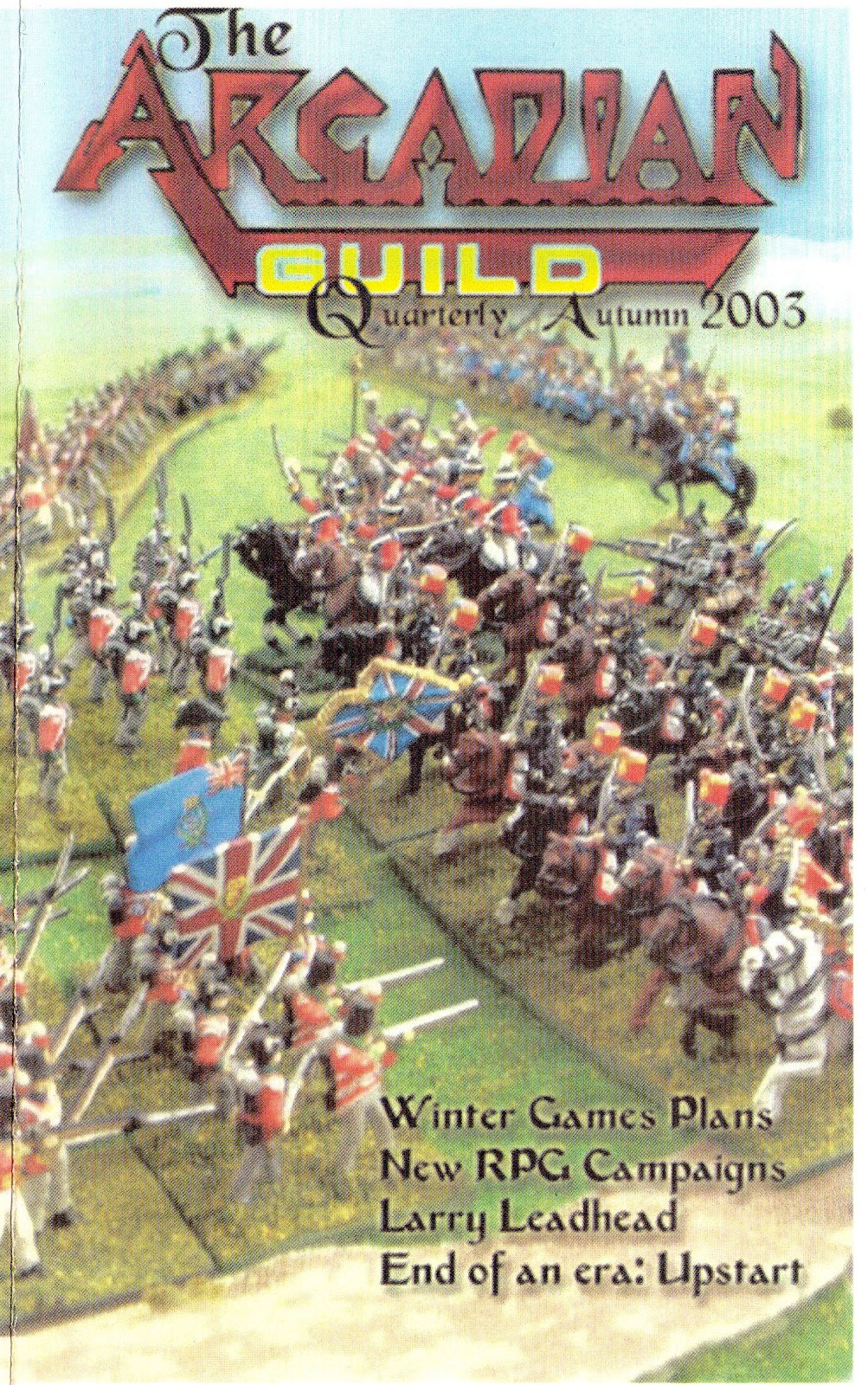
Cover of the Autumn 2003 Arcadian Guild Quarterly
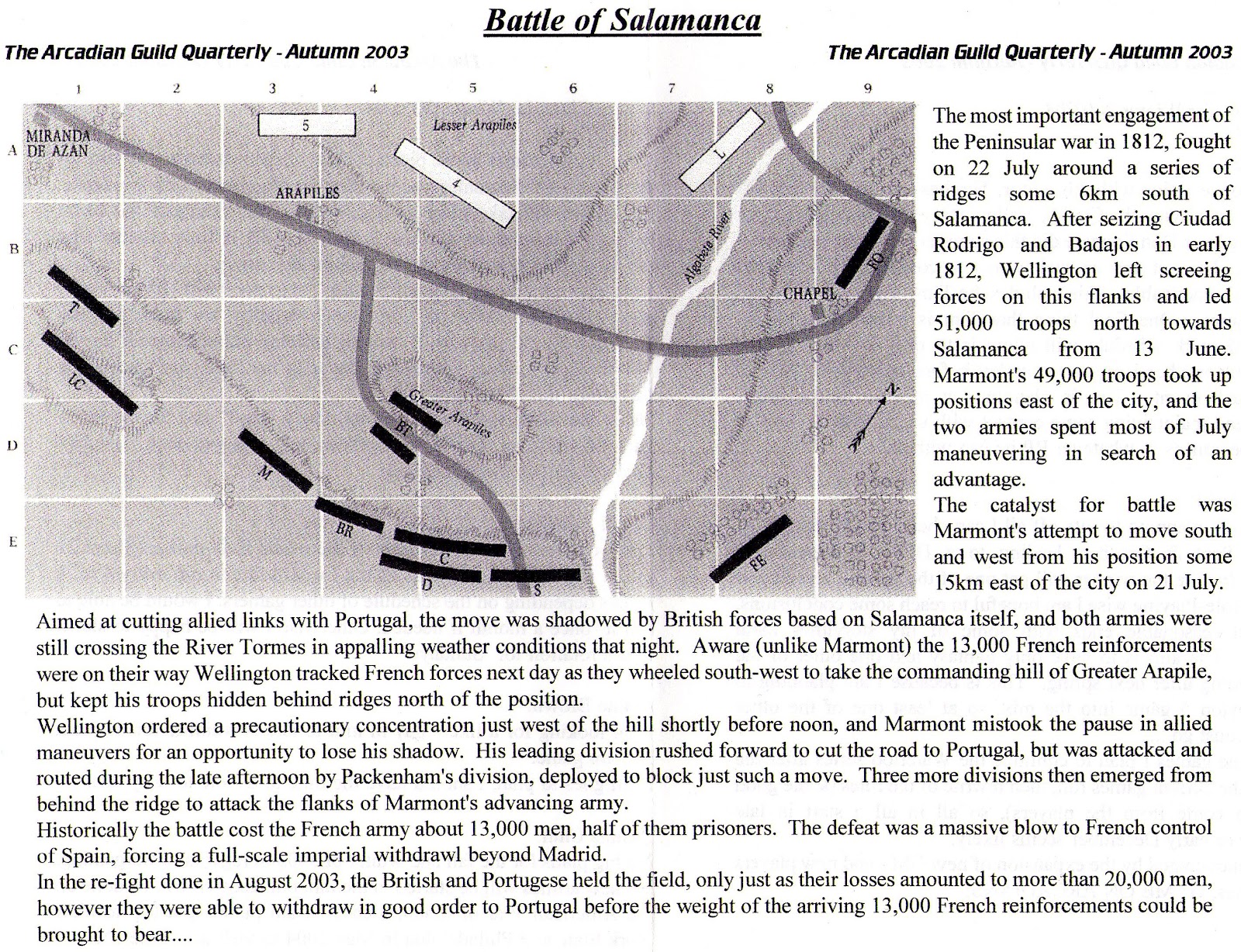
These past games did not have many photographs.  One, from 2003, did have many photos taken during the game, sadly the computer that they were stored on was destroyed in 2004 and I did not get any data from it archived onto CD's before the electrical storm that fried the whole computer struck.

The game featured on the cover was run in 15mm with Kelly Jones' collection, soon after he moved to Victoria.

summary of the re-fight of Salamanca from Autumn 2003 AGQ

Today I was inspired to pull out my 15mm minis, that are all setup for doing a Napoleonic version of Hordes of the Things, and put together a re-creation of the battle for this scale - using my own homebrew DBN rules.

I have a set of 12"x12" boards that have pre-set terrain on them, I have also made up a set of map generators, with a parchment feel, for setting up campaign game battles - formerly via e-mail (I did a series of Waterloo campaigns with them that worked out quite well - more about that some other time).

a parchment version of the map used in today's refight of Salamanca

The parchment blocks are not 'exact' copies of the boards, so the planning stages can have some unpredictability about them.

tabletop terrain and troops laid out 2' x 3'
This battle did not go so fast for the British, as their command die rolls were repeatedly horrible - for the first 4 turns (about one hour) they could only manage to move about 1/3 of their forces.  By turn 5 the artillery of both sides was finally able to come into action.

Artillery in a duel
Far on the British right, French left, the French cavalry had assembled and fell onto the flank of the British line.  The tactic almost worked, however it left the French cavalry in a vulnerable position backed into rough terrain.

The counter-attack from the British and Portuguese cavalry was enough to eliminate all of the French cavalry ... half way to victory!

raging artillery duel continued while British cavalry cut up their French counterparts
French lines continued to be broken up by the British artillery and the counter attack on the French right was not making any progress.  Every time they came to firing with the British, the French would come out on the loosing end of the die rolls.

British and Portuguese cavalry fall back, having lost 1/3 of their forces, meanwhile the French cannot get any effective fire into their counter attacks

Then a critical decision is made, the French commander moves into the line - preparing to make a push along with the left flank and at least take out one force of British foot.  This would put the commander into artillery range for one salvo at least ...

The British artillery did not miss!  Command was broken for one turn before devolving to the flag carrying infantry formation on the other side of the massed batteries.  Score was now British 3 : French 1

new French command is temporarily disordered from artillery fire (spiral marker)

New command took time to maneuver the line back into a battle ready action formation, meanwhile the British command rolls continued to be terrible.  Keeping the British from doing much more than get ready for the next French attack.

The line re-formed and charged, this time it did not fail and one British line unit was routed.

The counter attack and artillery barrage put the final nail in the coffin for the French as they lost one more unit of infantry ... final score British 4 : French 2, the French were forced to retire from the field - just as historically happened 200 years ago.

with only 3rd battalions of infantry to cover the left flank the French were obliged to start withdrawl

While searching for the old pictures of Salamanca, I came across this Larry Leadhead classic:

when was the last time you searched your 'lead mound'?

There were other great items for campaign work and game action photos that I have also found ... giving me more food for thought and some great 'looking back' material for future posts here with MurdocK's MarauderS

Saturday, July 21, 2012

Elusive foe ... a tale from two centuries ago.

Napoleon believed that Barclay would now make his own way down the Orsha road to hasten the junction with his colleague, and accordingly all units were ordered to concentrate at Kamen, ready to fight the long-sought battle.

Napoleon considers his next move.


Once again, however, the Emperor's intuition proved wrong.  True, the Russians were straining every nerve to reunite thier forces, but their designated place of meeting was Vitebsk, and not Polotsk as had hitherto been assumed by Napoleon.  By the 21st he had recognized his error, whereupon he ordered his troops to move from Kamen to Biechenkovski, which they were to reach by the 24th.  But nothing appeared certain.  "Will the foe come to Biechenkovski or move straight to Vitebsk?" he asked himself in a letter to Eugene.

~ D. Chandler, The Campaigns of Napoleon p778

Friday, July 20, 2012

Dutch Forces

Painted this week, 52 Dutch infantry.

bare metal to fully painted in one week 52 Dutch Infantry
I did this as something of a challenge, to see if I could stay on focus with the brushwork, while still maintaining a momentum with some business transactions.

The business transactions did the expected this time and gave me a gap on Sunday, Monday, Tuesday; permitting the paint time.  Now the paperwork for work has come back and I shall have to divert focus to get all that done.

Sunday, July 15, 2012

Convention Game Decided

With the 200th anniversary of the Battle of Maloyaroslavets coming on the 12th of October and the Dak-Kon game event on the 13th and 14th, the game to play decision was very simple.

Battle of Maloyaroslavets October 12, 1812
Now I must get on with the confirmation of the troops, I shall have to use blue coats for the French forces, though I am considering changing out the flags to Italian ones as it was a mostly Italian force under Eugene that did the fighting in this pivotal battle of the Russian campaign.

Further games are likely this week from either Garden Wars or FPGA as the 200th anniversary of Salamanca is this Sunday.

Wellington at Salamanca
Salamanca was one of the first tabletop battles I ever played out, Arapiles as it was known to the Spanish, was the name I played it as using Napoleon's Battles.  I shall have to see if I can find any old pictures.

Saturday, July 14, 2012

Bastille Day Parade

I decided to have my own Bastille Day Parade, Garden Wars style.

Line Infantry passes in review in front of Bonaparte and the Imperial Guard
I laid out my large buildings as terrain along with all the road sections that I have for the 25/28 mm scale.

I then set out the 'dais' of Bonaparte with his Imperial Guard to review the painted French troops marching past.

Heavy Cavalry of Cuirassier and Dragoons leads the column in review
The whole parade route in one photo.
From end to end it measured 4 yards or about 12 feet (the road is curved, and the troops are 'spaced' from each other, not packed tight.  Nor was the Imperial Guard in the marching column.  The troops were laid out in fighting lines or battle formations, with the artillery being pulled as a battery line abreast.

I estimate that were these troops to be laid out in proper march columns it would take another 8 yards to have them all marching along a single route.

In total I have some 405 French forces (some were not laid out as I have many more greatcoats - good for anybody really) and perhaps a dozen or so infantry that were not in the SHAKO formations (as I made by groups all 16 in number originally).

The Imperial Guard formed quite a sight with the long marching column going past.

Napoleon, the Marshals and Imperial Guard were the reviewing dais
Six years along now in this deeper Napoleonic experience and one miniature made me smile, as he appears in the very first posting in this blog.

A hot day again on the parade route, many years on and this Dragoon officer is still leading columns in my collection
Felicitation de La FĂŞte Nationale!